
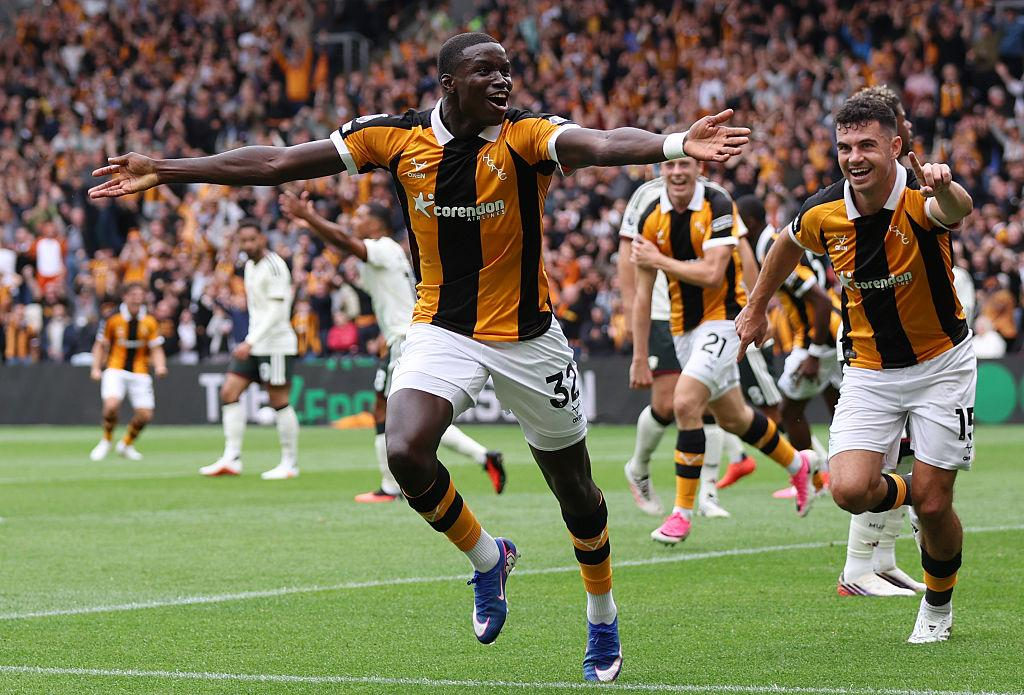
Manchester United vs Hull City produced a nightmare start to the 2026/27 Premier League season for Michael Carrick’s side. United travelled to the MKM Stadium expecting to begin their campaign with three points against newly promoted opposition, but instead returned home after a disappointing 2–0 defeat.
Semi Ajayi opened the scoring after 17 minutes before summer signing Nobel Mendy doubled Hull’s advantage in the 38th minute. Although Manchester United had the entire second half to respond, they failed to find a way back into the contest.
For Hull, it was a memorable return to the Premier League and their first top-flight victory over Manchester United. Meanwhile, Carrick was left with several important questions about his team’s intensity, organisation and attacking structure.
The manager has urged supporters not to panic after one match, and that message is understandable. However, the Manchester United vs Hull City performance exposed enough problems to make the coming weeks extremely important.
Manchester United vs Hull City: Match Summary
Competition: Premier League 2026/27
Date: August 22, 2026
Venue: MKM Stadium
Result: Hull City 2–0 Manchester United
Goalscorers
- Semi Ajayi — 17′
- Nobel Mendy — 38′
Both goals arrived before half-time, leaving Manchester United with a difficult task during the second half.
Hull did not simply survive against one of the Premier League’s biggest clubs. Instead, they identified United’s weaknesses, attacked them effectively and defended their advantage with impressive composure.
Manchester United enjoyed plenty of possession, but they did not use it well enough. Ultimately, that difference in efficiency explains the result.
1. Manchester United Were Not Ready for Hull’s Intensity
One of the most worrying aspects of the defeat was how quickly Hull established control over the occasion.
Promoted teams often begin their first home Premier League match with enormous energy. The crowd becomes louder, challenges become harder and every successful clearance can lift the entire stadium.
Manchester United knew what to expect, yet they still struggled to match Hull’s urgency.
The home side played with the determination of a team desperate to prove that it belonged in the Premier League. By contrast, United looked like a team still trying to understand exactly what it wanted to become under Carrick.
That uncertainty cannot continue for long. After all, opponents such as Liverpool, Arsenal and Manchester City will punish a lack of intensity even more ruthlessly.
2. Set Pieces Destroyed Manchester United
If Carrick wants to identify the clearest problem from the match, set-piece defending is the obvious place to start.
Hull scored both goals from dead-ball situations. Ajayi struck following a corner in the 17th minute, while Mendy headed home from another set-piece before half-time.
At this level, conceding twice in those circumstances is unacceptable.
Set-piece defending is not simply about having tall players in the team. Organisation is equally important, including who attacks the first ball, who tracks runners, who protects the second ball and who reacts when the original delivery is not cleared.
Too often, Manchester United failed those tests.
The second goal was particularly damaging because United needed to regain control before the interval. Instead, they gave Hull another reason to believe that a famous result was possible.
3. Manchester United Had the Ball, but Hull Had the Better Plan
The scoreline becomes more interesting when the performance is examined closely.
Manchester United were not completely dominated and enjoyed long periods of possession. They also produced 21 shots and around 1.83 expected goals, according to analysis of the match.
Those numbers might suggest that United were unfortunate. However, a closer look at the quality of the chances tells a different story.
Sixteen of those attempts were worth less than 0.1 xG each, while United’s average open-play shot quality was only around 0.087 xG.
In simple terms, Manchester United were shooting without consistently creating genuine danger.
That is a more serious issue than simply having an unlucky afternoon. A team can improve its finishing after one poor match, but repeatedly creating low-quality chances can point towards a deeper tactical problem.
4. Manchester United’s Attack Looked Blunt
Manchester United needed to find a goal quickly and then build enough momentum to chase an equaliser. However, their pressure rarely felt overwhelming.
Hull used a back five to crowd the central areas and force Carrick’s players towards less dangerous positions. The plan worked remarkably well.
United could circulate possession across the pitch, but Hull were comfortable allowing them to do so. The real problem arrived when Manchester United entered the final third.
There was too little movement, not enough penetration and insufficient quality around the penalty area. In addition, the team lacked the ruthless finishing required to turn pressure into goals.
Carrick clearly has work to do in this area. Possession only becomes valuable when it leads to genuinely dangerous situations.
5. Matheus Cunha as a False Nine Did Not Work
One of Carrick’s most interesting tactical decisions was using Matheus Cunha as a false nine.
The idea itself was understandable. Cunha can drop into midfield, receive between the lines, carry possession forward and connect the midfield with the attack.
However, somebody still needs to occupy the opposition’s centre-backs.
Manchester United frequently lacked that presence. As a result, Hull’s defenders could maintain their shape because there was not always a striker forcing them towards their own goal.
The experiment may work against different opponents. Against Hull’s compact defensive structure, though, it did not create enough threat.
6. Benjamin Sesko’s Absence Was Felt
Benjamin Sesko’s fitness issues restricted Carrick’s attacking options for the opening match.
Manchester United needed a player capable of attacking the penalty area, occupying defenders and providing a target when attacks moved into wide positions. Without that physical presence, Hull could focus more easily on blocking the spaces in which United’s creative players wanted to operate.
This does not mean Sesko would automatically have won the match. Football is rarely that simple.
Nevertheless, his absence changed the structure of United’s attack and reduced the options available to Carrick.
7. Youri Tielemans and Andrey Santos Need Time
Two of Manchester United’s important midfield additions endured difficult Premier League debuts for the club.
Youri Tielemans and Andrey Santos were unable to establish the midfield control Carrick would have wanted, and both players were eventually substituted.
That should not become an immediate judgement on either signing. Midfield partnerships take time to develop because players must understand when a teammate will move forward, when they need to provide cover, when to press and when to slow the game down.
They also need to know when to take risks.
Such understanding cannot always be created during pre-season. However, Manchester United will receive little patience, especially after losing 2–0 to a promoted club.
8. Bruno Fernandes Cannot Solve Everything
This has been a familiar Manchester United problem for several years.
When the attack stops functioning, supporters often look towards Bruno Fernandes for the solution. He is expected to find the decisive pass, create the chance, score the goal and ultimately change the match.
That is too much responsibility for one player.
Bruno can remain United’s most important creative footballer without becoming the entire attacking system. Carrick needs contributions from several areas of the pitch.
The wide players must create opportunities, midfielders need to break lines, full-backs have to support attacks and the striker should create space for teammates.
Otherwise, opponents can concentrate too much attention on Fernandes. Hull showed how effective that approach can be.
9. Hull Deserve More Credit
It would be unfair to describe this result only as a Manchester United failure because Hull were excellent.
The home side understood the occasion, defended with discipline, attacked United’s weaknesses and took their chances when they arrived.
When Manchester United attempted to respond, Hull’s defensive shape remained difficult to break down. Their back five was particularly effective at reducing the space available to United’s attackers.
This was Hull’s first Premier League match since 2017, yet they did not look overwhelmed by the occasion.
Instead, they produced one of the biggest results of the opening weekend.
10. Nobel Mendy Had a Dream Premier League Debut
Nobel Mendy could hardly have imagined a better introduction to Premier League football.
The summer signing arrived at Hull and immediately scored against Manchester United on his Premier League debut. His 38th-minute header made it 2–0 and completely changed the mood inside the stadium.
At 1–0, United could still believe that one moment would bring them back into the match. Mendy’s goal, however, changed the entire situation.
Hull could then defend deeper and protect their advantage, while Manchester United were forced to take greater risks. As a result, the crowd grew louder and the emotional momentum moved firmly towards the home side.
Mendy’s goal gave Hull control of an important part of the match.
11. Manchester United’s Defence Remains a Concern
The two goals naturally attract most of the attention. However, the defensive concerns go beyond the final score.
Manchester United did not look sufficiently organised during several important moments. Set pieces were the clearest problem, although there were also questions about defensive sharpness and the balance of Carrick’s back line.
Lisandro Martínez’s fitness situation has reduced the manager’s options, while Carrick is still searching for the right defensive combination.
That matters because United’s attacking approach requires security behind the ball. If the defenders cannot manage transitions and set pieces comfortably, the midfield becomes more cautious.
Consequently, the attack can also suffer.
Everything is connected.
12. Carlos Baleba Suddenly Looks Even More Important
Manchester United’s pursuit of Carlos Baleba was already one of the club’s biggest transfer stories.
After this performance, supporters will inevitably look towards the midfielder as someone capable of improving the team’s physical level. His energy, athleticism and ball-carrying ability could certainly help United.
However, Baleba cannot solve every problem on his own.
One midfielder cannot repair set-piece defending, improve finishing, organise the defence and create attacking chemistry simultaneously. Carrick must make sure that Baleba becomes another important piece of the system rather than the player expected to rescue it.
Read more about Carlos Baleba to Manchester United.
13. Carrick Is Right About One Thing: Don’t Panic
After the defeat, Carrick refused to treat one result as a crisis.
He stressed that it was only one match and said the defeat did not change the direction in which he believes Manchester United are heading.
That is the correct public response.
Imagine the alternative: one defeat arrives, and the manager immediately announces that everything has gone wrong. Such a reaction would achieve nothing.
Carrick needs to remain calm. However, calm cannot become complacency.
Manchester United have experienced too many false starts for another season to drift before September. Therefore, the response to this defeat must be measured but urgent.
14. Manchester United vs Hull City: The Bigger Concern Is the Attack
The two goals conceded will naturally dominate much of the conversation. Yet the attacking numbers may be even more worrying.
Manchester United produced plenty of shots but very few genuinely high-quality opportunities, and their best chance did not arrive until late in the match.
That suggests a structural problem rather than simply poor finishing.
If a striker misses three clear chances, it is reasonable to expect the finishing to improve. On the other hand, if the team barely creates clear chances, something deeper needs to change.
Carrick must find ways to get his forwards closer to goal. More runs in behind, better cut-backs and sharper combinations inside the penalty area would all help.
At the same time, United need fewer hopeful attempts from low-value positions.
15. One Defeat Does Not End Manchester United’s Season
It is important to keep the result in perspective.
Manchester United have played only one Premier League match, which means there are still 37 games remaining.
Players are returning to fitness, new signings are still settling into the team and the transfer window remains important. In addition, Carrick is still building his side.
There is plenty of time for improvement.
However, opening-day defeats create immediate pressure because the next match suddenly becomes more significant. A second defeat would change the conversation quickly, so United must make sure that does not happen.
For a wider look at the season, read Enigma Football’s Premier League 2026/27 Prediction.
What Manchester United Must Fix Immediately
Carrick does not need to redesign the entire team after one defeat. Instead, he needs improvement in several obvious areas.
Set-Piece Organisation
Set-piece defending must improve immediately because two preventable dead-ball goals changed the match.
Chance Quality
Manchester United need to create better opportunities. Twenty-one shots mean little if most of them come from positions that rarely produce goals.
The Striker Position
Greater clarity is needed in attack. Whether it is Sesko when fit or another option, United require someone who can regularly occupy the penalty area.
Midfield Chemistry
The relationships between Tielemans, Santos and Fernandes must continue to develop. Better understanding should eventually help the team control matches more effectively.
Intensity
Finally, United’s intensity has to improve. A Manchester United side cannot arrive at a newly promoted club and look less prepared for the occasion.
What Does Manchester United vs Hull City Mean for Michael Carrick?
The Manchester United vs Hull City result means Carrick’s honeymoon period is over quickly.
He knows the club, understands the expectations and recognises how one poor result can dominate a week of headlines. At the same time, he also knows that successful teams are not built through emotional reactions to individual matches.
The response must be practical.
Carrick needs to study why Hull’s back five caused problems, improve the team’s set-piece organisation, create better chances and raise the physical level of his players.
Then Manchester United must focus on winning the next match.
That is how this defeat can become an unpleasant opening-day memory rather than the beginning of another difficult season.
For another major Premier League clash, read the Newcastle vs Liverpool Prediction.
Final Thoughts
Manchester United vs Hull City was not the beginning Michael Carrick wanted for the 2026/27 Premier League season.
Semi Ajayi opened the scoring after 17 minutes before Nobel Mendy made it 2–0 before half-time. United then had more than 50 minutes, including stoppage time, to find a response.
None arrived.
That is the most worrying part of the defeat.
Hull deserve enormous credit for their performance. Their first Premier League match since 2017 produced their first Premier League victory over Manchester United, and they earned the result through discipline, intensity and effective tactics.
For United, there is no reason for panic after one match. There is, however, every reason for urgency.
The midfield needs time to develop, the defence requires better organisation and the attack must produce sharper movement and higher-quality chances.
Most importantly, Carrick needs to ensure that Manchester United’s new era does not begin by repeating too many problems from the old one.
One match does not define a season, but what Manchester United do next could tell us considerably more.
Internal Links :
- Bradley Barcola to Liverpool
- Enzo Fernández to Manchester City
- Bruno Guimarães to Arsenal
- Julian Álvarez to Arsenal
- Savinho to Tottenham