
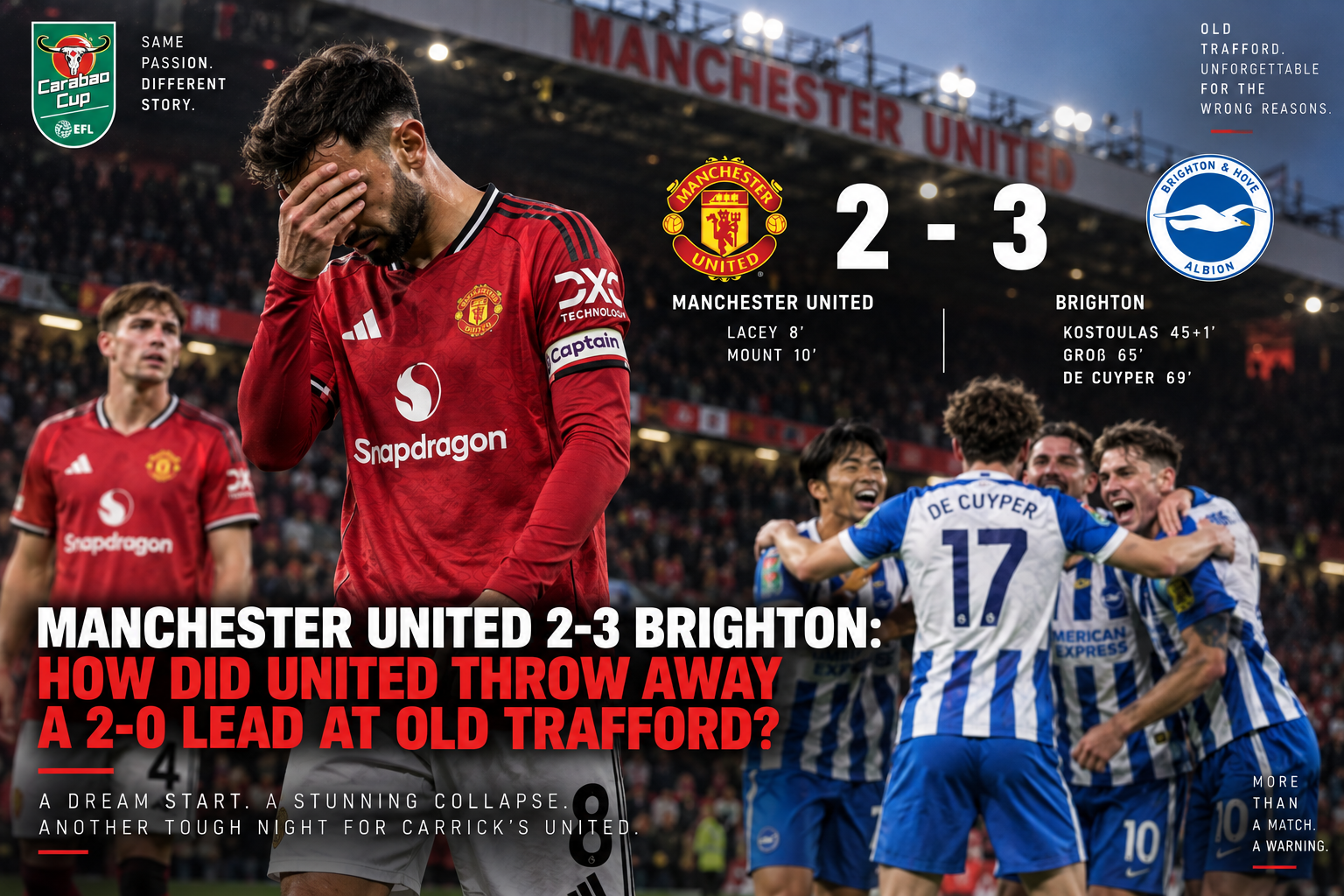
United could hardly have started better. Shea Lacey, making his first start for the club, put the home side ahead after eight minutes. Just two minutes later, Mason Mount doubled the advantage and gave United complete control of the opening stages. Manchester United Brighton
At 2-0, the match appeared to be heading in a straightforward direction. Brighton, however, had other ideas.Manchester United Brighton
Charalampos Kostoulas pulled one back in first-half stoppage time. That goal completely changed the mood around Old Trafford. Instead of entering the dressing room with a comfortable two-goal advantage, United suddenly had Brighton within one goal.Manchester United Brighton
The second half then belonged to the visitors. Pascal Groß equalised after 65 minutes before Maxim De Cuyper completed the comeback four minutes later.Manchester United Brighton
United never managed to recover.Manchester United Brighton
How Did Manchester United Lose After Leading 2-0?
The simple explanation is that United stopped doing the things that had initially given them control.
During the opening ten minutes, Michael Carrick’s team attacked quickly and purposefully. Brighton struggled to settle, while United took full advantage of the early pressure.
Once the second goal arrived, however, the tempo changed. Brighton were given more time on the ball and gradually began moving United around the pitch.
The statistics underline that shift. Brighton finished with 18 shots compared with United’s nine. The visitors also registered five efforts on target, while United managed four.
A team that led 2-0 after ten minutes eventually found itself being outshot by two to one.
That points to a loss of control rather than simply bad luck.
Kostoulas’ Goal Changed the Game
Going into half-time 2-0 ahead would have given United a completely different situation to manage. Instead, Kostoulas’ stoppage-time goal gave Brighton belief.
The timing was particularly damaging. Brighton entered the break knowing they needed only one more goal to draw level.
United, meanwhile, returned for the second half with their comfortable advantage reduced to just one goal.
That shift in momentum became increasingly important as the match progressed.
United Failed to Regain Control After Half-Time
Half-time offered Carrick an opportunity to reset his team and slow the match down.
United could have focused on longer spells of possession and forced Brighton to chase the ball. Another option would have been to reduce the tempo and concentrate on protecting the advantage.
Instead, Brighton continued to apply pressure.
The visitors created the better attacking moments, while United looked increasingly uncomfortable. When Groß equalised in the 65th minute, the goal felt like the result of pressure that had been building for some time.
Four minutes later, the situation became even worse.
Four Minutes Changed Manchester United’s Night
At 65 minutes, the score was 2-2.
By 69 minutes, Brighton were ahead.
That short period ultimately decided the tie. After conceding the equaliser, United needed to regain their composure and prevent the match from becoming chaotic.
Keeping possession, winning fouls and clearing dangerous situations could have helped United settle. Instead, Brighton sensed vulnerability and immediately attacked it.
De Cuyper’s winner arrived before United had properly recovered from Groß’s equaliser.
The visitors had completed the turnaround.
Manchester United’s Game Management Was Poor
Game management can sound like an abstract football phrase, but this match offered a clear example of what it means.
At 2-0, United needed to manage Brighton’s reaction. After Kostoulas made it 2-1, the priority became surviving the start of the second half.
Once the score reached 2-2, United needed to prevent the game from becoming even more open.
Those moments required different decisions. United did not adapt effectively enough to the changing circumstances.
The issue was not that the players suddenly forgot how to play football. Instead, they struggled to recognise what the match demanded at each stage.
Brighton Deserve Credit for the Comeback
United’s collapse should not overshadow Brighton’s performance.
Fabian Hürzeler’s side could easily have accepted that the match was slipping away after the opening ten minutes. Instead, Brighton remained patient and continued to play.
The visitors created chances, gradually pushed United backwards and grew in confidence as the game progressed.
Hürzeler had made six changes to his team, yet Brighton still found a way to compete after their difficult start.
Their reward was a place in the next round.
Shea Lacey Gave United a Major Positive
The result should not take away from Shea Lacey’s performance.
The 19-year-old scored just eight minutes into his first Manchester United start. For an academy player, few moments could provide a better introduction to Old Trafford.
Lacey played without appearing intimidated by the occasion and gave supporters another glimpse of his potential.
The defeat will dominate the headlines, but his first Old Trafford goal remains an important personal milestone.
Mason Mount’s Early Goal Should Have Settled United
Mason Mount’s goal arrived only two minutes after Lacey had opened the scoring.
At 2-0, United had almost every advantage. They were playing at home, the crowd was behind them and Brighton were under significant pressure.
That position should have allowed Carrick’s side to control the match rather than constantly searching for another goal.
Instead, the advantage disappeared.
Losing from such a strong position is one reason the defeat will attract more scrutiny than an ordinary cup elimination.
Brighton Had Twice as Many Shots
The final shot count provides another indication of how the game changed.
Manchester United: 9 shots
Brighton: 18 shots
Brighton also completed more passes and recorded slightly better passing accuracy.
Those numbers stand out because the visitors had conceded twice during the opening ten minutes. For the remainder of the match, Brighton were considerably more productive in attack.
United therefore did not lose because Brighton scored three speculative goals. The visitors repeatedly created situations from which they could threaten the United goal.
Why Did United’s Midfield Lose Control?
Midfield control is likely to be one of the main areas Carrick examines when reviewing the match.
United needed players capable of dictating the rhythm once Brighton recovered from their poor start. That control never consistently returned.
At times, possession changed hands too quickly and United’s defensive structure became exposed.
Protecting a lead requires midfielders to do more than create attacking opportunities. They must also recognise where danger is developing and when possession needs to be prioritised.
Sometimes the correct pass goes backwards. Holding the ball for another 30 seconds can also be more valuable than attempting an immediate attack.
United did not show enough of that judgement.
The Defensive Problems Have Not Disappeared
Carrick improved United considerably after returning to the club last season, but some weaknesses remain.
Brighton’s comeback exposed problems that have appeared before. United became stretched, while players were pulled away from their defensive positions.
The space between midfield and defence subsequently became easier for Brighton to attack.
Once the visitors gained confidence, United struggled to restore their shape.
The most concerning part was how quickly one setback turned into three conceded goals.
Good defensive teams can concede. The difference is how they respond when the pressure increases.
This Was a 50-Year First at Old Trafford
The historical statistic makes the result even more notable.
Manchester United had not lost at home after leading by two goals since September 1976, when Tottenham Hotspur won 3-2 at Old Trafford.
Half a century passed without the situation happening again.
Brighton have now ended that run.
United had previously held a two-goal lead at Old Trafford on 144 occasions without losing. The 145th occasion produced a very different outcome.
Carrick Accepted Responsibility
Michael Carrick did not attempt to hide from the performance.
After the match, he accepted responsibility for the way United played towards the end of the second half and acknowledged that the defeat could not simply be brushed aside.
The response on the pitch will now matter more.
United travel to Fulham in the Premier League next. Carrick needs his players to show that the Brighton defeat was an isolated collapse rather than evidence of a wider problem.
Is Michael Carrick Under Pressure?
Pressure is unavoidable at Manchester United, and Carrick understands the expectations surrounding the position.
The current results have increased the scrutiny. United have only one win from their opening four Premier League matches and have now suffered consecutive defeats against Manchester City and Brighton.
The League Cup campaign is also already over.
One poor week does not automatically determine a manager’s future. However, results will need to improve quickly if United are to avoid further pressure.
The Contrast With the Sabah Win Is Striking
Only a week earlier, United beat Sabah 4-0 in the Champions League.
That performance produced optimism. Benjamin Šeško scored, United looked comfortable and the club’s return to Europe’s leading competition appeared to offer evidence of progress.
Football can change quickly.
Since then, United have lost the Manchester derby and surrendered a 2-0 lead against Brighton.
The contrast highlights the consistency problem Carrick still has to solve.
United’s best football can be very good. Maintaining that level throughout difficult periods remains the bigger challenge.
What Does the Defeat Mean for United’s Season?
The immediate consequence is straightforward: one trophy is already gone.
There is also a potential scheduling benefit. United now have fewer fixtures and can concentrate more heavily on the Premier League and Champions League.
That will only become meaningful if performances improve.
An early League Cup exit will not feel like successful fixture management if United continue struggling in the league.
The free midweeks now need to become productive.
Can Manchester United Still Have a Good Season?
There is plenty of time left.
It is September, and the Premier League season is only four matches old. United are also back in the Champions League after producing an encouraging opening European performance against Sabah.
However, early-season results can expose problems that become harder to correct later.
United have already shown two very different versions of themselves. One side can score four against Sabah and play with confidence. Another can lead Brighton 2-0 at Old Trafford and still lose.
Carrick’s challenge is to make the first version more consistent and the second much rarer.
What Does Carrick Need to Fix?
The first issue is control. United cannot allow matches to become frantic whenever the opposition scores.
Defensive structure is another concern. When possession is lost, the distance between midfield and defence needs to remain manageable.
Mentality after setbacks also matters. Conceding one goal cannot automatically lead to another.
Finally, consistency remains essential.
Good teams are not judged only by their best 20 minutes. Their standards need to remain stable throughout the match.
Fulham Is Suddenly a Very Important Match
United travel to Fulham on Sunday.
Under normal circumstances, an away Premier League match in September would not carry enormous significance. The context is different now.
United have lost two consecutive matches and been knocked out of a cup competition. They also sit in the bottom half of the Premier League after the opening weeks.
Old Trafford has just witnessed a collapse that had not occurred there for 50 years.
A convincing response at Fulham would provide an opportunity to move the conversation forward. Another poor performance would bring further scrutiny.
Carrick knows the importance of the response, as do his players.
Final Verdict
Manchester United did not lose this match during the opening ten minutes. The collapse developed through everything that followed.
At 2-0, United had control. After Kostoulas made it 2-1, they still had the lead. Even at 2-2, there was time to regain command.
Those opportunities passed without a response.
Brighton deserve credit for remaining calm, creating chances and punishing United when the home side became vulnerable.
For Manchester United, the defeat exposes a familiar problem in a new season. The team can play excellent football, score early and produce convincing victories.
What remains difficult is controlling difficult periods when the momentum turns against them.
Carrick has accepted responsibility. The next step is finding a solution.
Losing a two-goal lead at Old Trafford for the first time in 50 years is therefore more than an unusual statistic. It highlights the need for United to become much more consistent.
Internal Links :
- Champions League 2026/27 Begins: Who Will Win the Trophy?
- Arsenal vs Chelsea: Is This the First Real Premier League Title Test of 2026/27?
- Premier League Table 2026/27: Matchweek 1
- Premier League’s £3.46 Billion Transfer Frenzy: The Biggest Deals, Winners & Losers of Summer 2026
- Lamine Yamal’s Barcelona Takeover: Is He Already the Face of La Liga?
- Harry Kane’s Bayern Munich Era: Can He Finally Turn Goals Into More Trophies?