
Few challenges in modern football are as frustrating as facing a low block.
You dominate possession.
You control territory.
But chances? Almost none.
Because when a team defends deep, compact, and disciplined—
👉 space disappears.
So how do elite teams break it?
Not through luck.
Not through random crosses.
👉 Through patterns, patience, and precision.
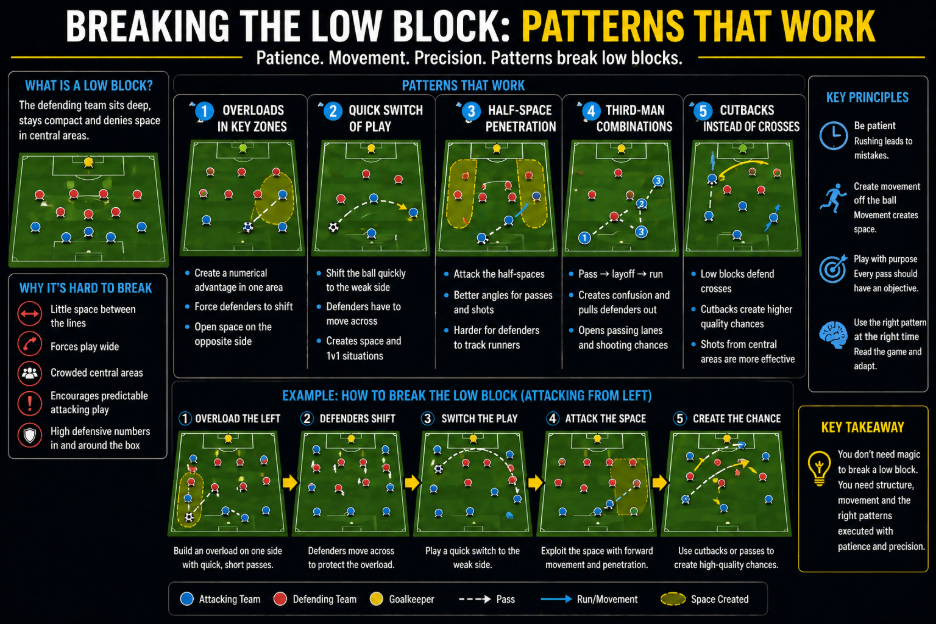
🧠 What is a Low Block?
A low block is a defensive setup where a team:
- Defends deep near their own penalty area
- Maintains tight vertical and horizontal compactness
- Reduces space between defensive lines
Teams like Atlético Madrid under Diego Simeone have perfected this structure.
👉 The objective is simple:
Deny space. Force mistakes. Stay organized.
⚙️ Why Low Blocks Are Hard to Break
Low blocks work because they:
- Limit space between players
- Force attackers wide
- Reduce central penetration
- Encourage predictable play
👉 The more impatient you become, the easier you are to defend.
🔑 Patterns That Actually Work
Breaking a low block requires structured, repeatable patterns—not improvisation.
1. Overloads in Key Zones
Create numerical superiority in one area of the pitch.
- 3v2 or 4v3 situations
- Force defenders to shift
- Open gaps elsewhere
Teams like Manchester City use this to manipulate defensive shape.
👉 Overload one side to free the other.
2. Quick Switching of Play
Once defenders shift toward the overload:
👉 Switch the ball quickly to the opposite side.
This creates:
- Space on the weak side
- 1v1 situations
- Crossing or shooting opportunities
Timing is everything.
3. Half-Space Penetration
The most dangerous zones against a low block are the half-spaces.
Players like Kevin De Bruyne thrive here.
Why?
- Better angles for passes and shots
- Harder for defenders to track
- Breaks defensive lines
👉 Central space is crowded. Half-spaces are opportunities.
4. Third-Man Combinations
Direct passing often fails against compact defenses.
So teams use:
- Pass → layoff → run
👉 The third-man movement creates unpredictability.
It pulls defenders out of position and opens gaps.
5. Cutbacks Instead of Crosses
Low blocks are built to defend crosses.
So instead of crossing blindly:
👉 Attack the byline and cut the ball back.
This creates:
- High-quality chances
- Shots from central areas
- Defensive confusion
⚠️ Common Mistakes
Many teams struggle because they:
- Move the ball too slowly
- Rely on hopeful crosses
- Lack off-ball movement
- Force play through crowded central areas
👉 Without structure, possession becomes meaningless.
🧩 Tactical Insight
Breaking a low block is less about creativity—
👉 And more about repetition and discipline.
Elite teams don’t try something new every time.
They repeat effective patterns until:
- The defense makes a mistake
- A gap appears
- A moment opens
⚡ Final Thought
Low blocks are designed to frustrate.
But they are not unbreakable.
👉 With the right patterns, patience, and precision—
even the most compact defenses will crack.
Because in football, control is not about having the ball…
👉 It’s about knowing what to do with it.