
Modern football is no longer defined by static formations.
Teams don’t simply defend in a 4-4-2 and attack in a 4-3-3—they transform instantly, often within seconds.
👉 The ability to switch from defensive structure to attacking shape is what separates elite teams from the rest.
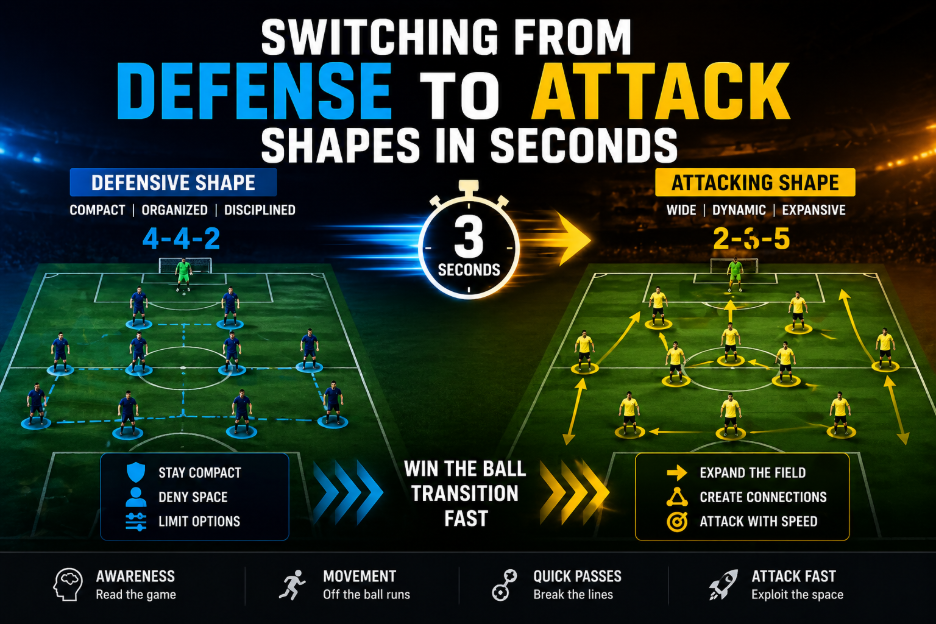
🧠 The Core Idea
Every team has two identities:
- Out of possession (defensive shape)
- In possession (attacking shape)
The key is not just having both—
👉 It’s how quickly you transition between them.
🔄 Defensive Shape: Compact & Disciplined
When defending, teams prioritize:
- Compactness between lines
- Narrow spacing to protect central areas
- Organized blocks (mid-block or low block)
Example:
A team may defend in a 4-4-2, with:
- Two banks of four
- Limited space between midfield and defense
👉 The goal: deny space and force predictable play.
⚡ Attacking Shape: Expansive & Dynamic
The moment possession is won, everything changes.
Players immediately:
- Spread out to create width
- Occupy advanced positions
- Form triangles and passing lanes
That same 4-4-2 might become:
👉 3-2-5 or 2-3-5 in attack
🎯 The Transition Moment (Key Phase)
The most critical moment is the first 3–5 seconds after winning the ball.
Why?
Because:
- Opponents are disorganized
- Defensive shape is broken
- Space is temporarily available
👉 This is when the shape shift must happen instantly.
⚙️ How Teams Execute Shape Shifts
1. Pre-Defined Roles
Players already know:
- Where to move when possession is won
- Which zones to occupy
👉 No hesitation = faster transitions.
2. Positional Rotation
Players don’t stay fixed.
- Fullbacks may invert into midfield
- Wingers stretch wide
- Midfielders push forward
Teams like Manchester City excel at this under Pep Guardiola.
3. Immediate Width & Depth
To attack effectively:
- Width → stretches defense horizontally
- Depth → pushes defense backward
👉 This creates space between lines.
4. Vertical Passing Intent
Instead of safe passes:
- Look forward immediately
- Break lines quickly
👉 Speed of thought matters more than speed of running.
🌟 Real-World Example
At Liverpool FC under Jürgen Klopp:
- Defend in compact shape
- Win the ball
- Instantly attack with vertical runs
👉 This is transition football at its peak.
⚠️ Risks of Poor Transition
If the switch is slow:
- Opponent reorganizes
- Space disappears
- Attack becomes predictable
Worse:
- Team becomes exposed during transition
👉 Balance is crucial.
🧩 Tactical Insight
The best teams don’t just “attack fast”—
👉 They change structure intelligently.
This requires:
- Tactical awareness
- Synchronization
- Rehearsed movement patterns
⚡ Final Thought
Football today is about moments, not just phases.
👉 The fastest teams in transition control the game.
Because when you can switch from defense to attack in seconds—
👉 You don’t just react to the game.
👉 You define it.