
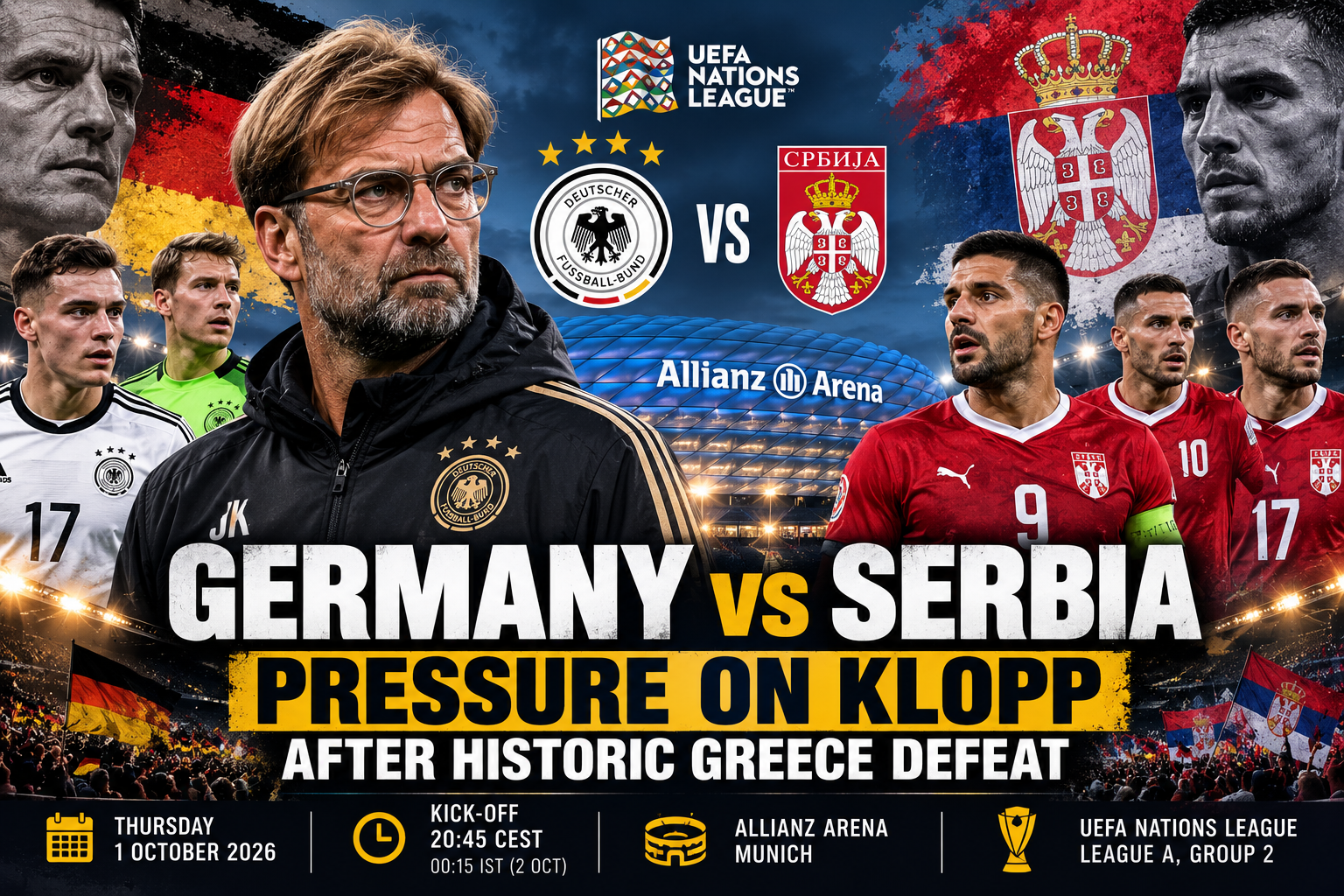
Jürgen Klopp has spent much of his managerial career working under intense pressure. Now, the Germany manager faces an early test as Germany vs Serbia takes centre stage in the UEFA Nations League.
Germany welcome Serbia to Munich on Thursday night still searching for their first victory under Klopp. The atmosphere around the national team has changed quickly after a draw with the Netherlands was followed by a historic 1–0 home defeat to Greece.
Greece had never previously beaten Germany in 10 meetings. Dimitris Kourbelis changed that in Augsburg, scoring in the 74th minute to give Greece a famous victory.
Germany now have one point from their opening two Nations League matches, while Serbia arrive in Munich without a point after two defeats.
For both teams, Germany vs Serbia is already an important fixture in their Nations League campaign.
Germany vs Serbia: Match Details
- Competition: UEFA Nations League 2026/27, League A, Group 2
- Match: Germany vs Serbia
- Date: Thursday, 1 October 2026
- Venue: Allianz Arena, Munich
- Kick-off: 20:45 CEST
- India time: 00:15 IST, Friday, 2 October 2026
Germany enter the match third in Group A2 with one point. Serbia are bottom after losing their opening two matches.
Greece have made the strongest start to the group, while the Netherlands are also above Germany after their victory in Belgrade.
For Klopp, the task is straightforward: Germany need a win.
Klopp Is Still Waiting for His First Germany Victory
Few appointments in international football have attracted as much attention as Jürgen Klopp taking charge of Germany.
The former Borussia Dortmund and Liverpool manager returned to management after Germany’s early exit from the 2026 World Cup. He inherited a national team looking to rebuild and restore confidence.
His first match offered encouragement but no victory.
Germany travelled to Amsterdam and drew 1–1 with the Netherlands after conceding a late equaliser.
Then came Greece.
Germany controlled large parts of the match in Augsburg and enjoyed overwhelming possession during the first half. However, possession did not translate into goals.
Greece remained disciplined, waited for their opportunity and eventually punished Germany.
Kourbelis struck with 16 minutes remaining, and Germany could not find a response.
After two matches, Klopp’s record with Germany is:
Played two. Won none. Drawn one. Lost one.
That is not yet a crisis, but pressure around Germany managers can build quickly.
Germany’s Defeat to Greece Was Historic
The defeat to Greece hurt for another reason.
Germany had never previously lost to Greece. Ten previous meetings had passed without a Greek victory before the Nations League match in Augsburg.
Greece changed that at the 11th attempt.
Germany dominated possession, particularly during the first half, but struggled to create enough clear chances.
Karim Adeyemi caused problems, while Joshua Kimmich forced goalkeeper Konstantinos Tzolakis into action with a free-kick. Felix Nmecha also had an opportunity.
None of those chances produced a goal.
Greece became increasingly dangerous as the second half progressed. Then Germany finally conceded.
Kourbelis’ deflected low effort beat the German defence and gave Greece a 1–0 victory.
It was also Klopp’s first home match in charge of Germany.
Klopp Knows Germany Need More Conviction
Klopp has not hidden his disappointment following the defeat.
The German coach acknowledged that several aspects of the performance were encouraging, but he was unhappy with the way the match slipped away.
Germany were not completely outplayed. Their bigger problem was turning control and possession into meaningful attacking opportunities.
Klopp has spent the build-up to the Serbia match working on that issue.
He expects Serbia to defend deep, which could create another difficult test for Germany.
Germany must move the ball quickly enough to break down a compact defensive structure while also protecting themselves when possession is lost.
Against Greece, that balance disappeared at a crucial moment.
Against Serbia, Klopp will want stronger counter-pressing, better defensive protection and quicker passing.
These are familiar principles from Klopp’s football, but the challenge is implementing them quickly at international level.
Why Germany vs Serbia Matters for Klopp
Three matches without a victory would not decide Klopp’s future, but it would increase the attention surrounding his opening months as Germany manager.
Germany are not treating the Nations League as a series of ordinary friendlies. This is the beginning of a new cycle following the 2026 World Cup.
Klopp has been tasked with building the next Germany side.
Results matter, but so does the identity of the team.
Supporters will want to see characteristics associated with Klopp’s teams: energy, pressing, quick transitions and confidence.
There were glimpses of those qualities against Greece, but Germany did not show enough of them.
The Germany vs Serbia match provides another opportunity to demonstrate progress.
Jonas Urbig Gets His Chance in Goal
Klopp has already confirmed one important selection decision.
Jonas Urbig will start against Serbia.
The Bayern Munich goalkeeper is set to make his senior Germany debut at his club’s home ground, the Allianz Arena.
For Urbig, it is a significant opportunity.
Germany are entering a new era in goal following Manuel Neuer’s international retirement, making the goalkeeper position an important part of Klopp’s rebuilding process.
Urbig has described representing Germany as something he has worked towards throughout his life.
His first assignment will be challenging.
Serbia have experienced attacking players and have scored in each of their opening Nations League matches.
A clean sheet would be an impressive start to his international career.
Germany Suffer Nico Schlotterbeck Injury Blow
Klopp will be without Nico Schlotterbeck for Germany vs Serbia.
The Borussia Dortmund defender injured his ankle during a warm-up exercise in training without contact from another player.
Klopp confirmed that Schlotterbeck would miss the match and return home following treatment.
It is an unwanted absence for Germany.
The team’s defensive organisation was already under scrutiny after Greece found the space needed to score in Augsburg.
Without Schlotterbeck, Klopp will need to reshuffle his defence while protecting an inexperienced goalkeeper.
Florian Wirtz Could Have a Bigger Role
Florian Wirtz is another player to watch.
Germany’s attacking problems against Greece make creativity especially important against a Serbia side expected to defend in numbers.
Wirtz has the technical ability to operate in crowded areas, receive the ball between midfield and defence and create opportunities in limited space.
Those qualities could prove important.
Germany are unlikely to break Serbia down simply by keeping possession.
They need players who can receive the ball under pressure, turn and force defenders into difficult decisions.
Wirtz can provide that creativity.
If Serbia sit deep, Germany’s attacking players will need to find ways through the defensive block rather than simply passing around it.
Serbia Arrive in Munich Under Pressure
Germany are not the only team searching for points.
Serbia have lost both of their opening Nations League fixtures.
They started with a 2–1 home defeat against Greece before suffering another 2–1 loss against the Netherlands in Belgrade.
Luka Jović scored against the Dutch shortly after coming on at half-time, but Netherlands striker Mexx Meerdink scored twice to secure the points.
The result left Serbia bottom of Group A2.
Another defeat would make their position even more difficult.
That makes Germany vs Serbia a potentially cautious contest.
Serbia have little reason to turn the match into an open game.
A compact defence followed by quick counter-attacks could present exactly the type of challenge that frustrated Germany against Greece.
Luka Jović and Filip Kostić Know German Football
There will be familiar faces in the Serbian squad.
Luka Jović and Filip Kostić both enjoyed important periods of their careers in the Bundesliga, particularly with Eintracht Frankfurt.
Jović remains a threat inside the penalty area.
Kostić provides experience, delivery and an understanding of German football developed over several seasons.
Klopp has described Serbia as an experienced team.
That experience could be important in a match where Germany are likely to have more possession.
Serbia will look to remain patient and wait for opportunities when Germany’s defensive structure breaks.
Greece demonstrated that one decisive moment can be enough.
The Tactical Problem Facing Germany
There is a temptation to simplify the match by saying Germany simply need to attack.
Klopp’s tactical challenge is more complicated.
If Serbia defend deep, Germany will push more players forward.
The full-backs may advance, midfielders will move closer to the Serbian penalty area and the centre-backs could be left defending larger spaces.
That is where Germany must improve.
Klopp has stressed the importance of Restverteidigung — the defensive structure a team maintains while attacking.
If Germany lose possession, the players closest to the ball must react immediately.
The first few seconds after losing possession could determine whether Serbia are able to launch a counter-attack.
Against Greece, Germany discovered the consequences of failing to provide that protection.
Germany Need More Than Possession
Possession statistics can sometimes hide the real story of a match.
Germany’s defeat against Greece was a clear example.
Klopp’s team had close to 80 per cent possession during the first half, but they still lost the match.
The problem was not Germany’s ability to keep the ball.
It was what they did with it.
Possession needs purpose.
Germany need quicker combinations around the Serbian penalty area, runners beyond the defensive line and enough width to stretch a narrow defence.
Most importantly, they need to finish their chances.
Germany cannot afford another match in which territorial dominance becomes an impressive statistic attached to a disappointing result.
Serbia Could Repeat the Greece Blueprint
Serbia will have studied Germany’s previous match carefully.
There is little reason for them to offer Klopp’s side the open spaces his football traditionally seeks.
A compact Serbian defence followed by quick attacks after turnovers could be an effective approach.
Klopp expects a similar challenge.
Breaking down a low block is difficult for any team, particularly for a side still learning a new manager’s system.
Germany must therefore show patience without becoming predictable.
Move the ball too slowly and Serbia can reset.
Attack recklessly and Serbia can counter.
Finding the balance will be crucial.
Germany vs Serbia Head-to-Head
Germany and Serbia have a long football history when meetings involving Yugoslavia and West Germany are included.
Their most recent meeting came in a 2019 friendly in Wolfsburg, with the teams drawing 1–1.
The previous competitive meeting is more memorable.
At the 2010 World Cup in South Africa, Serbia defeated Germany 1–0.
Milan Jovanović scored the winner after Miroslav Klose was sent off.
Sixteen years later, Germany again enter a competitive meeting carrying significant expectations.
Serbia will be aware of that pressure.
Allianz Arena Provides the Stage
The Allianz Arena provides an appropriate setting for a match attracting considerable attention.
Several Germany players know the stadium well through Bayern Munich.
For Jonas Urbig, it will be both a home game and his Germany debut.
Aleksandar Pavlović also has a personal connection to the fixture.
The Bayern midfielder was born in Munich to a German mother and Serbian father and was eligible to represent Serbia before choosing Germany internationally.
Germany will hope the familiarity of Munich works in their favour.
After the disappointment in Augsburg, another difficult home result would increase the scrutiny surrounding Klopp.
Is Jürgen Klopp Under Pressure?
Klopp is facing pressure, but two matches are not enough to judge an international manager.
He inherited a team coming out of a disappointing World Cup and has already begun experimenting with a large group of players.
International management also provides far less training time than club football.
Systems that Klopp could develop over months at Liverpool or Borussia Dortmund must now be taught during short international camps separated by weeks of club football.
That takes time.
However, expectations around Germany remain high.
A draw in Amsterdam was followed by a historic home defeat to Greece.
If Germany fail to beat Serbia, Klopp will travel to Greece on Sunday still searching for his first victory after three matches.
That would increase the attention around his start as Germany manager.
What Happens Next for Germany?
Germany’s schedule does not become easier.
After Germany vs Serbia, Klopp’s side travel to Greece on Sunday, 4 October.
The rematch arrives only one week after the defeat in Augsburg.
Germany will then complete the Nations League group phase in November with a trip to Serbia before hosting the Netherlands.
That makes the upcoming matches particularly important for Klopp’s team.
A win over Serbia would give Germany three important points and provide Klopp with a result to build upon.
Failure to win would leave Germany chasing the group and raise further questions about how quickly the new manager can turn possession and promising passages of play into results.
Germany vs Serbia: Players to Watch
Florian Wirtz — Germany
Germany need creativity against a compact Serbian defence.
Wirtz is capable of finding spaces that other players may not see. His movement between the lines and ability to combine in tight areas could be important.
Jonas Urbig — Germany
All eyes will be on Germany’s debutant goalkeeper.
Making his first senior international appearance at the Allianz Arena makes the occasion even more significant.
Aleksandar Pavlović — Germany
The Bayern midfielder’s Serbian family connection adds another dimension to the match.
His composure in midfield could also be important if Germany dominate possession for long periods.
Luka Jović — Serbia
Jović scored after coming off the bench against the Netherlands.
Germany know the former Eintracht Frankfurt striker can be dangerous around the penalty area.
Filip Kostić — Serbia
Experienced and direct, Kostić provides Serbia with an important outlet when they recover possession.
Germany cannot allow him too much space on the counter.
Germany vs Serbia: Frequently Asked Questions
When is Germany vs Serbia?
Germany play Serbia on Thursday, 1 October 2026.
What time is Germany vs Serbia?
Kick-off is at 20:45 CEST in Germany. In India, the match begins at 00:15 IST on Friday, 2 October.
Where is Germany vs Serbia being played?
The match will be played at the Allianz Arena in Munich.
What competition is Germany vs Serbia?
It is a UEFA Nations League League A Group 2 match.
Has Jürgen Klopp won a game as Germany manager?
Not yet. Germany drew 1–1 with the Netherlands in Klopp’s first match and lost 1–0 to Greece in his second.
Who beat Germany in their last match?
Greece defeated Germany 1–0 in Augsburg.
Was it Greece’s first win over Germany?
Yes. Greece’s victory was their first against Germany in 11 meetings.
Who scored against Germany for Greece?
Dimitris Kourbelis scored the winning goal in the 74th minute.
How many points do Germany have in the Nations League?
Germany enter the Serbia match with one point from their first two Group A2 games.
How many points do Serbia have?
Serbia have no points after losing their first two matches 2–1.
Who will start in goal for Germany against Serbia?
Jürgen Klopp has confirmed that Bayern Munich goalkeeper Jonas Urbig will start and make his senior international debut.
Is Nico Schlotterbeck playing against Serbia?
No. Klopp has confirmed that Schlotterbeck will miss the match after suffering an ankle injury in training.
When do Germany play next?
Germany travel to face Greece on Sunday, 4 October, three days after the Serbia match.
Final Thoughts
Jürgen Klopp has experienced difficult nights throughout his managerial career.
He knows that a new team cannot be built in two matches. However, international football rarely provides unlimited time for a project to develop.
Germany have one point.
They have no victories.
They have suffered their first defeat to Greece.
Now they return home to face a Serbia side also searching for points.
There were positive passages in Germany’s defeat to Greece. The team moved the ball well, controlled territory and spent long periods on the front foot.
But none of that changed the result.
For Germany vs Serbia, the immediate objective is simple: Germany need to turn control into goals and, ultimately, their first victory under Klopp.
A strong performance would give the team something to build on before Sunday’s return trip to Greece.
For Klopp, this is only game number three.
It already carries significant importance.
Internal Links :
- England vs Spain: Nations League Preview
- England vs Spain Injuries and Team News
- Portugal vs Wales: Nations League Preview
- Cristiano Ronaldo and Portugal
- Cristiano Ronaldo and Portugal: World Cup and International Career
- Lionel Messi Retirement: Why He Walked Away From Argentina and What Happens Next
- England vs Spain: World Cup Final Preview
- Premier League Table 2026/27: Matchweek 1
- Premier League’s £3.46 Billion Transfer Frenzy: The Biggest Deals, Winners & Losers of Summer 2026
- Lamine Yamal’s Barcelona Takeover: Is He Already the Face of La Liga?
- Harry Kane’s Bayern Munich Era: Can He Finally Turn Goals Into More Trophies?