
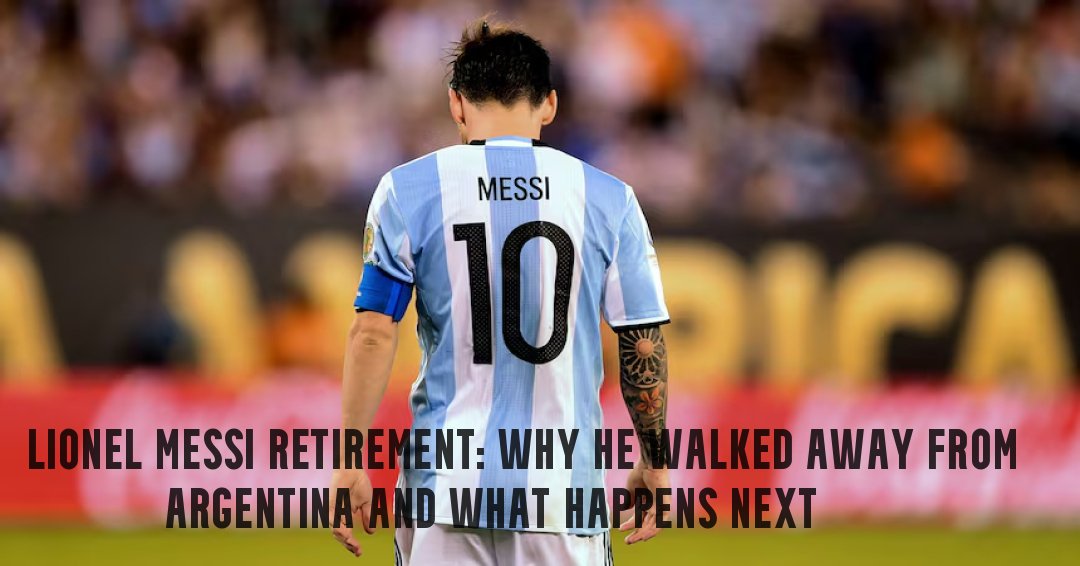
Lionel Messi retirement has officially brought one of the greatest international careers in football history to an end. On Monday, August 31, 2026, Messi announced that he was stepping away from the Argentina national team after 21 years wearing the famous blue and white shirt.
The 39-year-old has not retired from football altogether. He remains a key player for Inter Miami in Major League Soccer. However, Argentina’s No. 10 now belongs to the next generation.
Messi’s decision arrived quietly. Rather than holding a press conference or announcing a farewell tour, he shared a handwritten letter on Instagram.
It marked the end of an extraordinary international journey that included six World Cups, two Copa América titles and the 2022 World Cup.
For Argentina, replacing Messi will be almost impossible.
For football, it is the closing chapter of an era.
When Did Messi Announce His Retirement?
Messi announced his Lionel Messi retirement on the morning of August 31, 2026.
The announcement came roughly six weeks after Argentina’s 1–0 extra-time defeat to Spain in the 2026 World Cup final in New Jersey.
Interestingly, Messi revealed that he had written his retirement letter on July 21, only two days after the World Cup final.
He then waited more than a month before publishing it.
That delay suggests the decision was not simply an emotional response to Argentina’s defeat.
Instead, Messi had time to consider his future before making the announcement public.
Why Did Messi Retire From Argentina?
Two major factors appear to have influenced Messi’s decision.
The first was the physical and emotional demands of playing international football at the highest level for more than two decades.
At 39, Messi has already experienced almost everything the game can offer.
He has played in six World Cups, multiple Copa América tournaments and countless international matches.
The second factor was deeply personal.
In August 2026, Messi’s father and long-time agent, Jorge Messi, passed away.
His father’s death came only weeks after Argentina’s World Cup final defeat and appears to have strengthened Messi’s decision to end his international career.
The Lionel Messi retirement therefore appears to be the result of a decision he had been considering for some time rather than a reaction to one disappointing result.
Messi Has Walked Away From Argentina Before
This is not the first time Messi has announced his international retirement.
After Argentina lost the 2016 Copa América final to Chile on penalties, Messi briefly announced that he was finished with the national team.
The decision lasted only a few months.
Argentina supporters campaigned for Messi to return, and eventually he did.
What followed transformed his international legacy.
Messi won the 2021 Copa América, helping Argentina defeat Brazil in the final.
One year later, he reached the greatest prize of all.
Argentina defeated France in the 2022 World Cup final in Qatar, giving Messi the World Cup trophy that had eluded him throughout his career.
This time, however, the situation feels different.
There is little indication that Messi intends to reverse his decision.
Inside Messi’s Retirement Statement
Messi’s retirement message was handwritten and published in Spanish.
The tone was more grateful than emotional.
He reflected on his time with Argentina and expressed pride in what he and his teammates had achieved together.
That distinction is important.
Messi did not leave the national team because he had lost affection for Argentina.
Instead, he appeared to believe that the time had come to step aside after giving everything he could to the shirt.
His message also recognised the difficult years of his international career.
Before Argentina began winning major trophies, Messi faced criticism from supporters and pundits who questioned whether he could reproduce his club success with the national team.
The 2021 Copa América and 2022 World Cup changed that conversation forever.
Lionel Messi’s Argentina Career by the Numbers
The numbers behind Messi’s international career are extraordinary.
- 21 years with Argentina’s senior national team
- 207 appearances
- 125 goals
- 68 assists
- Six World Cups
- One World Cup title
- Two Copa América titles
- Two World Cup Golden Ball awards
- 21 World Cup goals during the 2026 tournament
Messi’s 207 appearances make him Argentina’s most-capped player, while his 125 goals make him the country’s all-time leading scorer.
His international statistics place him among the most successful players in football history.
This Is Not Full Retirement
The phrase Lionel Messi retirement needs one important clarification.
Messi has retired from international football.
He has not retired from professional football.
He remains with Inter Miami in MLS and is expected to continue his club career.
That means supporters will still have opportunities to watch Messi play regularly.
The major change is that Messi will no longer represent Argentina in future World Cup or Copa América campaigns.
The captain’s armband, the national-team No. 10 shirt and the responsibility of leading Argentina now move to the next generation.
What Happens to Messi at Inter Miami?
Messi’s next chapter will take place at club level.
Inter Miami remains his home, and the Argentine superstar is expected to continue playing in MLS.
That could allow Messi to manage his workload differently while still competing at a high level.
It also gives him the opportunity to spend more time focusing on his club career without the physical demands of international tournaments.
For Inter Miami supporters, the Lionel Messi retirement announcement therefore does not mean the end of Messi’s playing career.
It simply means fewer international commitments.
How Football Reacted to Messi’s Retirement
The reaction to Messi’s decision was immediate.
Players, former teammates, opponents and supporters from around the world paid tribute to one of the defining footballers of the modern era.
Messi’s career has also been closely connected with Cristiano Ronaldo and Neymar, two players who helped define the same generation.
The rivalry between Messi and Ronaldo became one of the biggest stories in football history.
Yet their careers also produced enormous mutual respect.
Messi’s international retirement therefore represents more than Argentina losing its greatest player.
It signals the continuing end of an era that dominated world football for almost two decades.
What Happens to Argentina Without Messi?
Argentina cannot simply replace Messi.
The national team must instead build a new identity around a younger generation.
Many of Argentina’s current players have spent much of their careers playing alongside Messi.
Now they will have to take greater responsibility.
The next Copa América and the 2030 World Cup cycle will therefore become important tests for Argentina.
The challenge will not only be replacing Messi’s goals and assists.
It will also involve replacing his leadership, creativity and ability to influence matches.
Argentina’s coaching staff will have to find a new attacking structure without relying on the player who has been at the centre of the team for so long.
Who Could Become Argentina’s Next Leader?
Argentina still possesses significant talent.
The national team has a strong group of players capable of carrying the team into its next era.
However, there will not be another Messi waiting to take over his exact role.
Instead, Argentina are likely to distribute the responsibility among several players.
The next captain may become particularly important.
Argentina also need a new creative focal point and a player capable of deciding matches when the team is under pressure.
That transition will take time.
Messi’s Legacy With Argentina
The Lionel Messi retirement debate ultimately comes back to one question:
Did Messi deliver for Argentina?
The answer is now impossible to dispute.
For years, Messi was criticised because Argentina repeatedly fell short in major finals.
He lost the 2014 World Cup final to Germany.
He then suffered consecutive Copa América final defeats.
But Messi eventually changed the story.
He won the Copa América in 2021.
He won the World Cup in 2022.
He also returned to another World Cup final in 2026.
That means Messi leaves Argentina having won the biggest trophies available to him.
His international legacy is complete.
Messi’s Most Important Argentina Moments
Several moments stand above the rest.
2014 World Cup Final
Messi led Argentina to the World Cup final in Brazil.
Argentina ultimately lost 1–0 to Germany in extra time, but Messi won the Golden Ball as the tournament’s best player.
2021 Copa América
Messi finally won his first major international trophy with Argentina.
The victory over Brazil at the Maracanã became one of the most emotional moments of his career.
2022 World Cup
This was the defining achievement.
Messi scored seven goals during the tournament and played a central role in Argentina’s run to the final.
Argentina defeated France on penalties after a dramatic 3–3 draw.
Messi finally became a World Cup champion.
2026 World Cup
Messi returned for what became his sixth World Cup.
Argentina reached the final again but lost 1–0 to Spain after extra time.
Six weeks later, Messi announced his international retirement.
Will Messi Play at the 2030 World Cup?
It is extremely unlikely.
Messi would be 43 when the 2030 World Cup takes place.
More importantly, his retirement statement makes clear that his Argentina career has ended.
The next World Cup will therefore belong to a new generation of Argentine players.
For the first time since the mid-2000s, Argentina will enter a major tournament without Messi as its central figure.
What Does Messi’s Retirement Mean for World Football?
The impact goes beyond Argentina.
Messi has been one of the central figures of football for more than 20 years.
His rivalry with Ronaldo.
His battles with Barcelona’s biggest opponents.
His World Cup triumph.
His Copa América victories.
His move to Inter Miami.
Each stage helped shape the modern game.
Now the international chapter is over.
The football world will continue to watch Messi at club level, but major tournaments will feel different without him.
Frequently Asked Questions
Is Lionel Messi retiring from football completely?
No. Messi is retiring from international football with Argentina. He is expected to continue his club career with Inter Miami in MLS.
When did Messi announce his Argentina retirement?
Messi announced his retirement from the Argentina national team on August 31, 2026, through a handwritten statement shared on Instagram.
How many goals did Messi score for Argentina?
Messi finished his international career with 125 goals in 207 appearances for Argentina.
Did Messi win a World Cup?
Yes. Messi won the 2022 FIFA World Cup with Argentina in Qatar.
Why did Messi retire from Argentina?
Messi’s decision was influenced by the physical demands of international football at 39 and the recent death of his father, Jorge Messi.
Will Messi play in the 2030 World Cup?
It is extremely unlikely. Messi has announced his international retirement and would be 43 during the 2030 World Cup.
Final Thoughts
The Lionel Messi retirement marks the end of one of the greatest international careers football has ever seen.
For 21 years, Messi wore the Argentina shirt.
He experienced heartbreaking defeats, intense criticism and painful final losses.
But he also experienced moments that few footballers could ever dream of.
A Copa América title.
A World Cup triumph.
Another World Cup final.
Individual records that may stand for generations.
And, most importantly, a legacy that can no longer be questioned.
Messi leaves Argentina with pride rather than regret.
His international career is finished, but his football career continues.
Inter Miami will still have their No. 10.
Argentina, however, must now learn how to play without theirs.
The Messi era is over.
The next era of Argentine football begins now.
Internal Links
- Ballon d’Or 2026 Power Rankings
- Best Goals of FIFA World Cup 2026
- FIFA World Cup 2026 Semifinal Schedule
- Spain Have the Tournament’s Best Defence
- Erling Haaland’s Historic FIFA World Cup Journey