
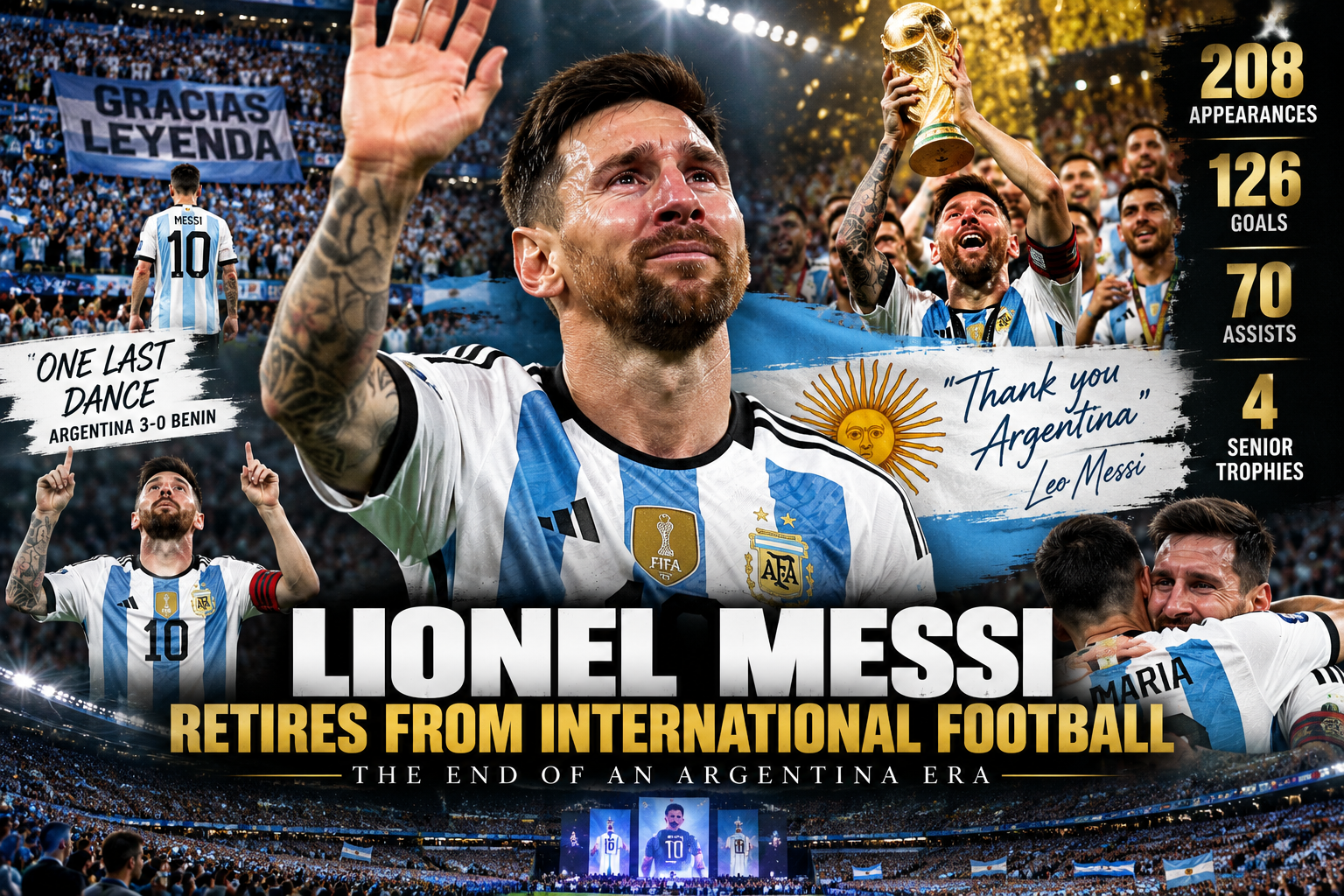
Lionel Messi retirement marks the end of one of the greatest international careers in football history.
After 21 years, 208 appearances, 126 goals, a World Cup, two Copa América titles and countless unforgettable nights, Argentina’s legendary No. 10 has finally walked away from international football.
His farewell could hardly have been more fitting.
Argentina defeated Benin 3–0 at the Monumental in Buenos Aires. Messi scored the final goal and created the other two, giving more than 85,000 supporters the perfect final memory of a player who carried their hopes for more than two decades.
There were tears before the match.
There were tears during it.
And there were plenty more when it ended.
But this time, Argentina were not crying because Messi had lost another final.
They were simply saying thank you.
Lionel Messi Retirement: His Final Match for Argentina
Messi’s international career ended where it belonged: in Argentina, wearing the famous No. 10 shirt and playing in front of supporters who had eventually learned to love him without reservation.
The farewell match against Benin was never going to feel like an ordinary friendly.
The entire evening was built around Messi.
Former teammates attended, families joined the celebrations and supporters filled the Monumental hours before kick-off.
During the 10th minute, play was paused as the stadium rose to applaud Argentina’s No. 10.
Then Messi gave them one final performance.
After a goalless first half, his corner created Nicolás Otamendi’s opening goal.
Messi then supplied Nico Paz for Argentina’s second.
In the 71st minute, he stepped forward from the penalty spot and scored himself.
Argentina 3–0 Benin.
One goal and two assists for Messi.
It was an almost perfect ending to his international career.
Messi Retires With 126 Goals in 208 Argentina Appearances
The final numbers tell an extraordinary story.
Messi finished his senior Argentina career with:
- 208 appearances
- 126 goals
- 70 assists
- 135 victories
- Four senior international trophies
- One World Cup
- Two Copa América titles
- One Finalissima
He is Argentina’s record appearance-maker and record goalscorer.
His 21-year senior international career began against Hungary in August 2005 and ended against Benin in Buenos Aires in October 2026.
There may never be another Argentina career quite like it.
Not simply because of the numbers, but because of everything that happened between his first and final appearances.
Messi’s Argentina Debut Lasted Barely 90 Seconds
There is something remarkably fitting about the beginning and ending of Messi’s international career.
His final match was carefully prepared as a national celebration.
His first was a disaster.
Messi made his senior Argentina debut against Hungary in Budapest on August 17, 2005.
He was only 18 years old.
He came off the bench and was sent off moments later.
His debut had lasted roughly 90 seconds.
The young Messi left the field devastated.
Twenty-one years later, he left international football as Argentina’s most-capped player, greatest goalscorer and World Cup-winning captain.
Football rarely provides endings this neat.
Argentina Almost Lost Messi Before His Career Started
Messi’s relationship with Argentina was complicated from the beginning.
He had left Rosario for Barcelona as a boy, developed in Spain and played his youth football at La Masia.
Spain were interested in securing his international future.
Argentina, remarkably, were initially slow to recognise exactly what they had.
The Argentine Football Association eventually moved to bring Messi into its youth system.
He never seriously wanted to represent another country.
For all the accusations that would later follow him — that he was too European, too quiet or too distant from Argentina — Messi’s decision was clear.
He wanted the blue and white shirt.
That decision would eventually cost him plenty of pain.
For Years, Argentina Asked Why Messi Wasn’t Maradona
To understand the significance of Lionel Messi retirement, it is important to remember that Argentina did not always adore him in the way it does today.
There were years when Messi was heavily criticised.
At Barcelona, he appeared unstoppable.
With Argentina, trophies refused to arrive.
Every major international tournament brought comparisons with Diego Maradona.
Maradona had delivered the 1986 World Cup.
Why couldn’t Messi do the same?
It was an unfair question, but it followed him everywhere.
When Barcelona won, Messi was the genius.
When Argentina lost, some supporters questioned why the same player could not reproduce his club success for his country.
Critics even accused him of lacking the emotional connection to Argentina that Maradona had displayed so visibly.
Those accusations hurt.
The relationship between Messi and Argentina had to be built slowly.
The 2014 World Cup Nearly Gave Messi Everything
Brazil 2014 appeared to be the moment Messi had been waiting for.
He dragged Argentina through difficult matches and into the World Cup final.
Germany stood between him and the trophy.
Argentina had chances.
Gonzalo Higuaín had one.
Rodrigo Palacio had another.
Messi himself had an opportunity.
None went in.
Mario Götze eventually scored for Germany in extra time.
Argentina lost 1–0.
Messi was named the tournament’s best player, but the individual award offered little comfort.
The image of Messi walking past the World Cup trophy became one of the defining photographs of his international career.
He had come within touching distance.
But he still had not won it.
Then Came the Copa América Heartbreak
The World Cup defeat was followed by even more disappointment.
Argentina reached the Copa América final in 2015.
They lost to Chile on penalties.
A year later, the teams met again in the Copa América Centenario final.
Again, the match went to penalties.
Again, Argentina lost.
This time, Messi missed his penalty.
It broke him.
After the match, Messi announced that his career with the national team was over.
He was only 29.
For a brief period, it appeared that the greatest Argentine player of his generation would finish his international career without a senior trophy.
Argentina Begged Messi to Come Back
Something changed after Messi’s 2016 retirement announcement.
Instead of blaming Messi for another defeat, Argentina asked him not to leave.
Supporters gathered behind the message that Messi should reconsider.
Politicians spoke about it.
Teammates wanted him back.
Children held signs asking him to return.
The reaction revealed something important.
Argentina had begun to understand Messi differently.
The defeats were no longer simply his failures.
People recognised that he had repeatedly carried the country to major finals.
Messi eventually reversed his decision.
He came back.
That decision changed Argentine football history.
The Lowest Point Came Before the Greatest Years
Even after Messi returned, success was not immediate.
Argentina struggled.
The 2018 World Cup ended with a chaotic defeat to France in the last 16.
Messi was approaching his thirties, and the questions grew louder.
Would he ever win something with Argentina?
Would his international career always be remembered for what was missing?
Then Lionel Scaloni took charge.
Slowly, Argentina changed.
A younger group emerged around Messi.
Rodrigo De Paul, Lautaro Martínez, Emiliano Martínez, Cristian Romero and others brought a different personality to the team.
More importantly, Messi no longer seemed burdened by the national team.
He appeared to enjoy playing for Argentina again.
Argentina had finally become his team in every sense.
Copa América 2021 Changed Everything
The breakthrough came at the Maracanã.
Argentina faced Brazil in the 2021 Copa América final.
Ángel Di María scored.
Argentina defended.
The final whistle blew.
Messi dropped to his knees.
His teammates immediately ran towards him.
For the first time in his senior international career, Lionel Messi was a champion with Argentina.
The trophy changed the conversation overnight.
The old question disappeared.
He had finally won something for his country.
But Messi was not finished.
Messi Finally Won the World Cup in Qatar
December 18, 2022 settled whatever arguments remained about Messi’s international career.
Argentina faced France in one of the greatest World Cup finals ever played.
Messi scored.
Kylian Mbappé answered.
Messi scored again.
Mbappé answered again.
After 120 minutes, the score was 3–3.
Penalties decided the match.
Gonzalo Montiel converted the winning kick.
Argentina were world champions.
Messi lifted the World Cup.
The trophy that had escaped him in 2014 was finally in his hands.
For Argentina, it was the country’s first World Cup since Maradona’s team won in Mexico in 1986.
For Messi, it completed the career.
There was no longer a missing trophy.
Qatar Transformed Messi’s Relationship With Argentina
The celebrations after Qatar showed how dramatically Messi’s relationship with Argentina had changed.
Millions filled the streets.
Buenos Aires became a sea of blue and white.
Messi was no longer simply the Barcelona superstar who happened to play for Argentina.
He was Argentina’s captain.
Their World Cup winner.
Their No. 10.
The player once criticised for supposedly lacking passion had become the emotional centre of the national team.
It had taken years.
Perhaps that made the bond even stronger.
Messi Won Another Copa América in 2024
Winning the World Cup could easily have been the perfect moment for Messi to stop.
He continued.
Argentina won another Copa América in 2024, giving their captain another major international trophy.
By then, Argentina had established a remarkable run of success:
- Copa América 2021
- Finalissima 2022
- World Cup 2022
- Copa América 2024
The player who had once been defined internationally by lost finals was suddenly surrounded by trophies.
Football had completely rewritten the story.
The 2026 World Cup Became Messi’s Final Tournament
Messi still had one more World Cup in him.
At 39, he represented Argentina at the 2026 tournament in the United States, Canada and Mexico.
It was his sixth World Cup.
Argentina again reached the final.
This time there would be no repeat of Qatar.
Spain defeated Argentina, leaving Messi with another painful World Cup final defeat.
But the reaction was nothing like 2014.
Nobody seriously questioned his legacy.
Nobody asked whether he had failed Argentina.
That argument had ended years earlier.
Messi left the tournament as a World Cup winner, a two-time Copa América champion and one of the most decorated international players of his generation.
He had nothing left to prove.
Why Did Lionel Messi Retire From International Football?
The decision behind Lionel Messi retirement came after the 2026 World Cup.
Messi explained that the time had come to close this part of his career.
Age was inevitably a factor.
Messi was 39.
He had played international football for more than two decades.
A new generation was emerging.
There was also personal grief.
Messi’s father had died, and that loss reinforced his decision that it was time to step away.
In his retirement message, Messi spoke about how deeply the decision hurt.
He also made clear that he believed younger players deserved their opportunity.
This was not an angry retirement.
It was not 2016.
There was no penalty miss, no frustration and no feeling that he had been defeated by international football.
This time, Messi was leaving on his own terms.
Lionel Messi’s Final Argentina Match
Argentina arranged one final appearance.
Benin were the opponents.
The Monumental was the stage.
More than 85,000 supporters arrived for what was effectively a national farewell.
There were tributes from teammates and former teammates.
The stadium rose in the 10th minute.
Fireworks filled the night.
Argentina’s colours illuminated the occasion.
Messi was visibly emotional.
Then, as he had done so many times before, he played football.
One assist.
Then another.
Then one final goal.
The script could hardly have been improved.
Messi’s Final Argentina Goal
Messi’s 126th and final international goal came from the penalty spot in the 71st minute against Benin.
There was no World Cup at stake.
No Copa América.
No desperate qualifier.
But few of his goals will have carried the same emotional weight.
Everyone inside the stadium knew it was the last one.
Messi had scored for Argentina as a teenager.
Goal number 126 was different.
It was goodbye.
Messi’s Argentina Career in Numbers
Messi leaves international football with records that will be extraordinarily difficult to match.
- Argentina appearances: 208
- Argentina goals: 126
- Argentina assists: 70
- Argentina victories: 135
- World Cups played: 6
- Senior international trophies: 4
- Copa América titles: 2
- World Cup titles: 1
- Finalissima titles: 1
He also won the 2005 Under-20 World Cup and Olympic gold with Argentina in 2008.
Numbers do not completely explain Messi’s career.
But they provide a useful place to start.
How Many World Cups Did Messi Play?
Messi appeared at six World Cups:
- 2006 — Germany
- 2010 — South Africa
- 2014 — Brazil
- 2018 — Russia
- 2022 — Qatar
- 2026 — United States, Canada and Mexico
He reached three World Cup finals.
Argentina lost to Germany in 2014.
They defeated France in 2022.
They finished runners-up again in 2026.
His World Cup journey therefore covered almost every possible emotion.
A teenage prospect.
A young superstar.
A devastated finalist.
A criticised captain.
A world champion.
And finally, a veteran leader saying goodbye.
How Many Trophies Did Messi Win With Argentina?
At senior level, Messi won four major trophies with Argentina:
- Copa América 2021
- Finalissima 2022
- FIFA World Cup 2022
- Copa América 2024
If youth and Olympic honours are included, he also won the 2005 FIFA Under-20 World Cup and 2008 Olympic gold medal.
For years, people said Messi needed an international trophy.
He retired with six titles across Argentina’s different levels.
Messi’s Greatest Argentina Achievement
The obvious answer is the 2022 World Cup.
It is difficult to argue otherwise.
Messi was 35.
Argentina lost their opening match to Saudi Arabia.
Their tournament could have unravelled immediately.
Instead, Messi scored a crucial goal against Mexico and helped drive Argentina through the competition.
Then he lifted the trophy.
But perhaps the deeper achievement was not simply winning the World Cup.
It was changing his relationship with Argentina.
The boy who was once regarded by some as too European retired as a national symbol.
That transformation took nearly two decades.
Messi and Maradona: Argentina No Longer Needs to Choose
For years, discussion of Messi inevitably led to Maradona.
Who was greater?
The debate will never disappear.
It probably should not.
Football supporters enjoy these arguments.
But Messi’s later career made the comparison less important.
Maradona gave Argentina 1986.
Messi gave Argentina 2022.
They did it in different eras, in different ways and with different personalities.
Argentina has room for both.
Messi vs Ronaldo: The International Careers
Messi’s retirement inevitably renews comparisons with Cristiano Ronaldo.
Their rivalry defined an era of football.
They competed for Ballons d’Or, Champions Leagues, goalscoring records and the unofficial title of the greatest player of their generation.
Their international careers followed different paths.
Ronaldo became Portugal’s record goalscorer and helped his country win Euro 2016 and the Nations League.
Messi became Argentina’s record scorer and appearance-maker while winning the World Cup, two Copa América titles and the Finalissima.
The argument over which career was greater will continue long after both men stop playing.
What matters more is that football had them at the same time.
That was the privilege.
What Happens to Argentina Without Messi?
Now comes the difficult part.
Argentina have spent more than 20 years with Lionel Messi somewhere in the picture.
Even when injured, absent or temporarily retired, every discussion eventually returned to him.
That is over.
Lionel Scaloni must now build an Argentina team that does not expect Messi to return.
There are talented players ready to take responsibility.
Julián Álvarez has years ahead of him.
Lautaro Martínez remains an elite striker.
Nico Paz represents the emerging generation.
Argentina have quality throughout the squad.
But replacing Messi is not simply about finding another right-sided attacker or another No. 10.
They have to replace an identity.
That takes time.
Who Will Wear Argentina’s No. 10 After Messi?
Few shirts in world football carry more history.
Maradona wore it.
Messi wore it.
Now somebody else must.
Whoever receives Argentina’s No. 10 next will face an impossible comparison.
The sensible approach is not to search for “the next Messi”.
There isn’t one.
Argentina should allow the next generation to develop its own identity.
The shirt will remain.
The player wearing it will have to make it his own.
Can Argentina Remain Successful Without Messi?
Yes.
But success will look different.
The encouraging part for Argentina is that the national team built during the Scaloni era was never composed entirely of players waiting for Messi to rescue them.
Emiliano Martínez became decisive.
Romero became a defensive leader.
De Paul provided energy and personality.
Álvarez and Lautaro contributed goals.
Mac Allister and Enzo Fernández became major midfielders.
Argentina developed a genuine team.
That is one reason Messi was finally able to succeed internationally.
The same structure now gives Argentina a chance to survive his departure.
Messi Leaves Differently This Time
The contrast with 2016 could not be greater.
Then, Messi walked away broken.
Argentina had lost another final.
He had missed a penalty.
He appeared tired of carrying expectations that never seemed satisfied.
In 2026, he leaves as a World Cup-winning captain.
Argentina’s record goalscorer.
Argentina’s record appearance-maker.
A two-time Copa América champion.
And, perhaps most importantly, a player completely loved by supporters who once struggled to understand him.
That is the ending he earned.
From Budapest Tears to Buenos Aires Tears
Messi’s senior Argentina career began with tears in Budapest.
It ended with tears in Buenos Aires.
Everything between those two nights explains why his story with Argentina became so compelling.
It was never easy.
Had Messi simply arrived, dominated and won immediately, the story might have been less powerful.
Instead, he failed.
Then he won.
That persistence is as important to his Argentina legacy as the goals.
Lionel Messi Retirement: Frequently Asked Questions
Has Lionel Messi Retired From International Football?
Yes. Lionel Messi retirement from international football came after his final match for Argentina against Benin in October 2026.
What Was Lionel Messi’s Final Argentina Match?
Messi’s final international appearance came in Argentina’s 3–0 friendly victory over Benin at the Monumental in Buenos Aires.
Did Messi Score in His Final Argentina Match?
Yes. Messi scored Argentina’s third goal from the penalty spot and also provided two assists.
How Many Goals Did Messi Score for Argentina?
Messi finished his senior Argentina career with 126 goals.
How Many Games Did Messi Play for Argentina?
Messi made 208 senior appearances for Argentina.
How Many Assists Did Messi Have for Argentina?
FIFA lists Messi’s final Argentina total at 70 assists.
How Many Trophies Did Messi Win With Argentina?
Messi won four senior trophies: the 2021 Copa América, 2022 Finalissima, 2022 FIFA World Cup and 2024 Copa América.
He also won the 2005 Under-20 World Cup and Olympic gold in 2008.
How Many World Cups Did Lionel Messi Play?
Messi played in six World Cups between 2006 and 2026.
Did Messi Win the World Cup?
Yes. Messi captained Argentina to the 2022 FIFA World Cup title in Qatar.
How Many Copa América Titles Did Messi Win?
Messi won the Copa América twice, in 2021 and 2024.
When Did Messi Make His Argentina Debut?
Messi made his senior international debut against Hungary on August 17, 2005.
How Long Did Messi Play for Argentina?
His senior international career lasted just over 21 years, from August 2005 until October 2026.
Why Did Lionel Messi Retire From Argentina?
Messi felt the time had come to close his international career after more than two decades, with younger players emerging. His decision also came during a deeply emotional period in his personal life.
Who Will Replace Messi for Argentina?
There can be no direct replacement for Messi.
Argentina are expected to distribute greater responsibility among their next generation rather than trying to find another player capable of performing exactly the same role.
Who Will Wear Argentina’s No. 10 After Messi?
Argentina have not established a permanent long-term successor to Messi’s No. 10 shirt.
Whoever inherits it will inevitably face enormous attention.
Is Messi Still Playing Club Football?
His retirement concerns international football with Argentina. It does not, by itself, mean retirement from club football.
Lionel Messi’s Argentina Story Is Complete
For most of Lionel Messi’s international career, something always seemed unfinished.
Then came Qatar.
After that night in 2022, Messi did not owe Argentina anything.
Everything that followed was an encore.
And finally, one last night at the Monumental.
He scored.
He created two more.
Argentina won.
And the country stood to applaud him.
There will be debates about Lionel Messi for decades.
Messi or Maradona.
Messi or Ronaldo.
Those arguments are part of football, and they will continue.
But Argentina no longer has anything left to ask of him.
Lionel Messi gave them 21 years, 208 appearances, 126 goals and the trophy they had waited 36 years to see again.
The boy from Rosario who once struggled to convince his own country ended his career as its captain, champion and symbol.
Lionel Messi’s international career is over.
The story will last much longer.
Internal Links
- Cristiano Ronaldo Portugal Crisis: What Happened and Could He Walk Away?
- Cristiano Ronaldo Portugal Return: The Latest on His International Future
- Portugal vs Norway: Ronaldo and Haaland Face Off
- France vs Italy: European Heavyweights Collide
- Germany vs Serbia: International Football Preview