
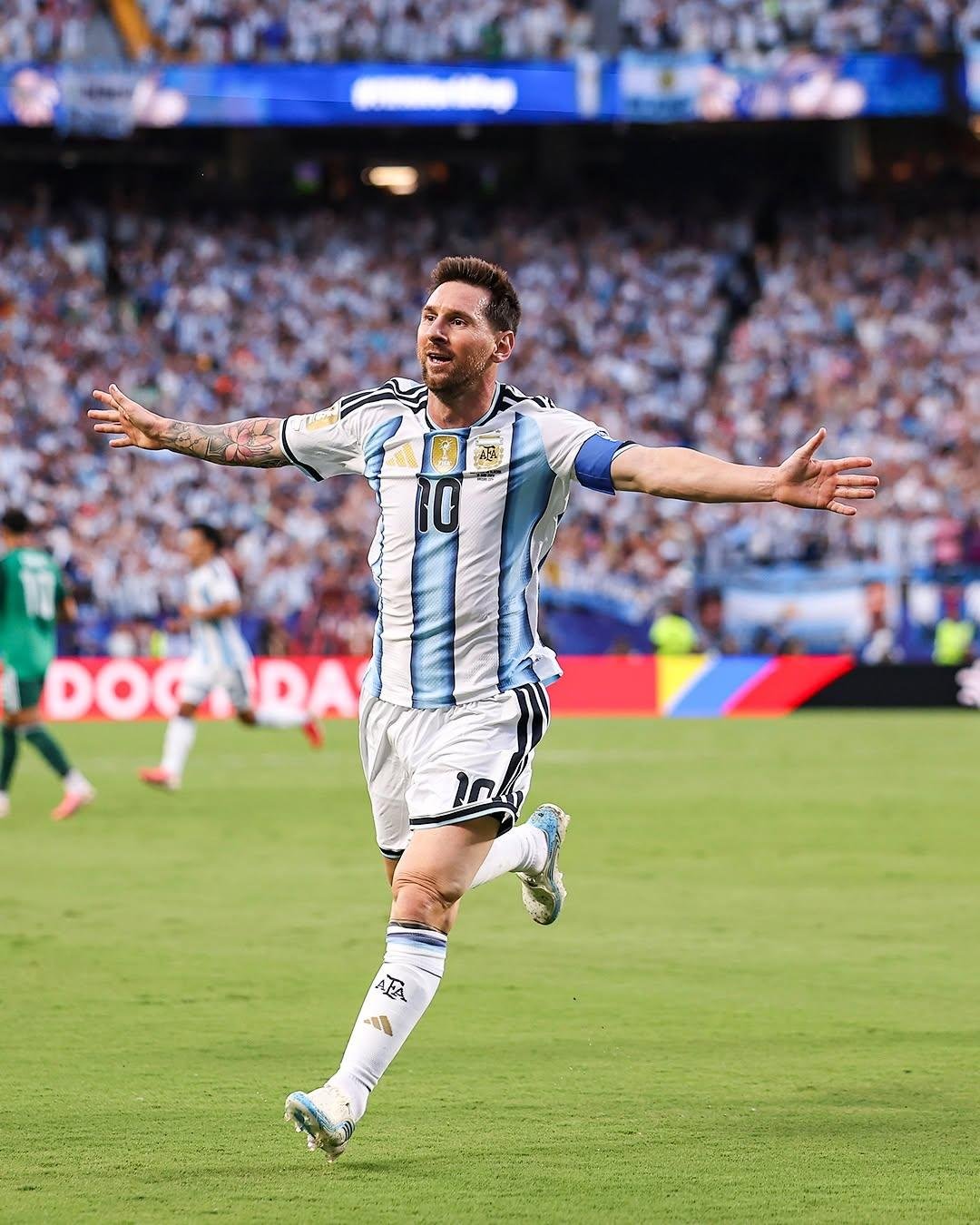
Lionel Messi’s road to another World Cup title comes down to one final match. Argentina will face Spain at New York New Jersey Stadium on July 19. The defending champions have won all seven of their matches so far. Once again, Messi has become the central figure in their pursuit of the trophy.
At 39, he no longer plays every minute at full speed. Instead, he chooses his moments. He moves into spaces other players fail to notice. And he still changes matches with a single pass or touch. His two late assists in Argentina’s 2-1 semifinal win over England were the latest proof.
Messi has already completed football once. But Messi’s road to another World Cup title would push his international legacy into territory no modern player has reached.
Argentina’s Road to the FIFA World Cup 2026 Final
Argentina’s journey has not been straightforward. They have scored freely, but they have also had to survive several difficult knockout matches.
| Stage | Opponent | Result |
|---|---|---|
| Round of 32 | Cape Verde | Argentina won 3-2 |
| Round of 16 | Egypt | Argentina won 3-2 |
| Quarterfinal | Switzerland | Argentina won 3-1 |
| Semifinal | England | Argentina won 2-1 |
| Final | Spain | July 19, 2026 |
Argentina have won every match at the tournament so far. Their run has been built on attacking quality, experience, and the ability to stay calm when matches turn against them. Messi has been at the centre of it all.
A Brilliant Start to the Tournament
Messi began the FIFA World Cup 2026 in outstanding scoring form. He scored a hat-trick against Algeria, then added further goals through the group stage. His finishing stayed sharp. But his wider influence mattered just as much. He dropped into midfield, carried the ball through pressure, and created chances for Argentina’s forwards.
The tournament quickly became more than a farewell appearance. Messi wasn’t simply participating. He was shaping it.
Meanwhile, Argentina’s younger players kept running, pressing, and stretching opponents around him. That structure let Messi conserve energy and focus on the moments that mattered most.
Cape Verde Push Argentina to the Limit
Argentina’s first knockout match brought an unexpected test. Cape Verde played with courage and twice threatened to derail the defending champions. Argentina eventually won 3-2, but the match needed extra time and far more effort than expected.
Messi scored during the contest. He also helped Argentina hold their composure once the match turned chaotic.
The result revealed something important about this Argentina side. They no longer overwhelm every opponent. But they still have the experience to survive. Champions rarely have a perfect run — most need to win at least one match where their football isn’t at its best. Cape Verde was that match for Argentina.
Argentina Survive Another Thriller Against Egypt
Egypt presented another difficult challenge in the Round of 16. Argentina won 3-2, but again they had to work until the closing stages. Messi stayed central to the attack, drawing defenders and opening space for teammates to run into.
The match showed how Argentina have evolved around their captain. Messi no longer needs to dribble through an entire defence. His movement alone can pull a midfielder out of position. His pass can release a runner. His presence can force an opponent to change its shape entirely.
That influence has become one of Argentina’s greatest weapons heading toward the rest of the FIFA World Cup 2026.
Messi’s Road to Another World Cup Milestone
Argentina’s quarterfinal win over Switzerland brought another personal milestone. Messi recorded his tenth World Cup assist, becoming the first player in recorded tournament history to reach double figures.
The record reflects the full range of his World Cup career. He has scored important goals, yes — but he has created just as many. Across different tournaments and different Argentina teams, Messi has remained both a finisher and a playmaker.
His role in 2026 has combined those two qualities. He began the competition as one of its top scorers. He now enters the final having produced one of its best creative performances too.
The Semifinal Masterclass Against England
Argentina’s semifinal against England looked like it was slipping away. Anthony Gordon gave England the lead, and Thomas Tuchel’s side defended it deep into the second half. Argentina needed inspiration. Messi provided it.
In the 84th minute, he created the equaliser for Enzo Fernández. In stoppage time, he supplied another decisive pass for Lautaro Martínez, completing a dramatic 2-1 comeback.
Messi didn’t score. But he decided the match.
That performance captured the difference between the younger Messi and the player who will face Spain in the final. Earlier in his career, he might have tried to beat several defenders alone. Now, he waits for the exact moment to release the ball. His speed may have changed — his understanding of the game hasn’t.
More Than Goals and Assists
Messi’s contribution can’t be measured through statistics alone. Argentina’s players look to him when a match becomes tense. His calmness settles the whole team. When opponents press aggressively, he gives Argentina a way out. When the tempo gets too quick, he slows it back down.
Lionel Scaloni has also built a team that knows how to protect its captain. Rodrigo De Paul provides energy and defensive cover. Enzo Fernández and Alexis Mac Allister control midfield. Julián Álvarez and Lautaro Martínez make the forward runs that create space around Messi.
Argentina no longer depend on Messi doing everything. They depend on him doing the most important things.
The Golden Boot Race at the FIFA World Cup 2026
Messi enters the final as one of the leading contenders for the FIFA World Cup 2026 Golden Boot. His two assists against England strengthened his position in the race. Messi’s road to another World Cup honour could be settled in this single match, since the Spain game may decide both the World Cup winner and the tournament’s top individual awards.
The Golden Boot would be another major achievement. But it’s unlikely to be Messi’s main concern — the trophy is what matters.
Spain Present the Toughest Test
Spain will be Argentina’s most difficult opponent of the tournament. They reached the final by beating France 2-0 and have conceded only one goal all tournament. Their defensive strength comes from more than a solid back four — Spain defend through possession, counter-pressing, compact positioning, and midfield control.
Messi will need to find space around Rodri and between Spain’s midfield and defence. That won’t be easy. Spain also know his style well. Messi spent most of his club career in Spanish football, and several members of the Spanish setup grew up studying his game.
The final will carry another major storyline: Messi against Lamine Yamal. Yamal represents Spain’s new generation. Messi represents an era that has shaped football for nearly two decades. Their meeting gives the final a symbolic quality — but the tactical battle around them will matter more than the comparison.
What Argentina Must Do to Win
Argentina must stop Spain from controlling the match for long periods. If Spain settle into their passing rhythm, Argentina may end up defending for too long. So Scaloni’s midfield will need to press carefully, win second balls, and attack quickly the moment possession changes hands.
Patience will matter too. Spain have been hard to break down all tournament, so Messi may need to drop deeper to receive the ball. That could open room for Álvarez or Lautaro Martínez to attack behind the defensive line.
Set pieces could also prove decisive. In a final between two organised teams, one free kick, corner, or penalty might decide everything.
What Another FIFA World Cup 2026 Title Would Mean
Messi won his first World Cup in Qatar in 2022. Messi’s road to another World Cup would make Argentina the first nation to retain the men’s title since Brazil in 1962. It would also place Messi among the very small number of players to win multiple World Cups.
More importantly, it would complete an extraordinary late chapter in his international career.
For years, critics said Messi couldn’t reproduce his club success with Argentina. Since then, he has answered that directly — winning the Copa América, the Finalissima, the World Cup, and several individual honours with his country.
Another title wouldn’t just strengthen his legacy. It would turn the final years of his career into one of football’s greatest stories.
Final Thoughts
Lionel Messi’s road to another World Cup title has included goals, records, difficult matches, and one unforgettable semifinal comeback.
He has led Argentina through Cape Verde, Egypt, Switzerland, and England. At times, he carried the scoring burden himself. At others, he controlled matches through passing and intelligence.
Now, only Spain remain.
Argentina face the tournament’s strongest defence, one of its best midfields, and a fearless new generation led by Lamine Yamal. Messi has faced almost every possible challenge in football. On July 19, he will face one more.
One victory would give Argentina back-to-back World Cups — and Lionel Messi another place in history.
Internal Links