
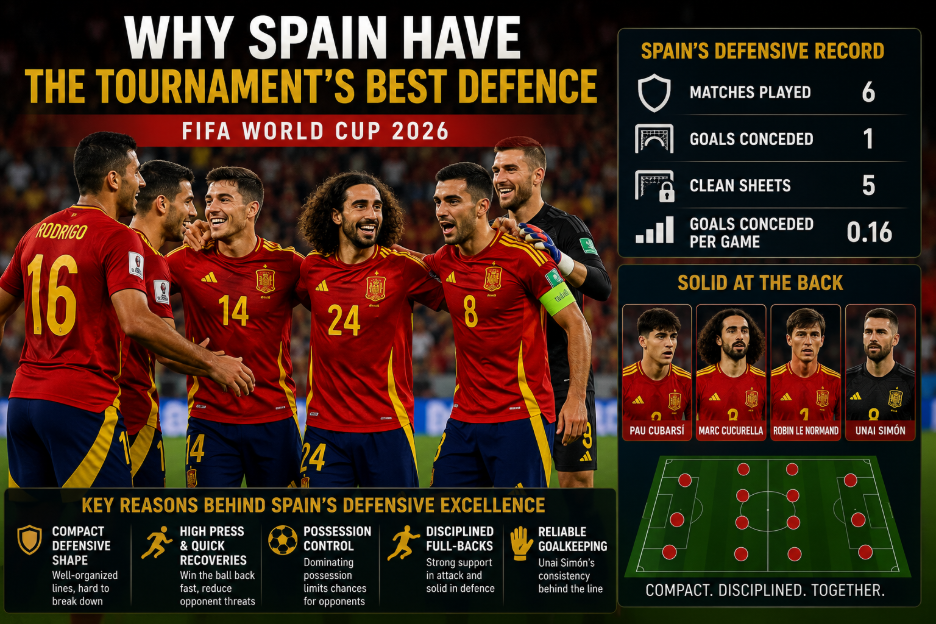
Spain arrived at the FIFA World Cup 2026 with a reputation for possession, technical quality, and attacking football. As the tournament has progressed, however, another part of their game has become impossible to ignore. Spain Best Defence World Cup 2026
Spain have built the best defensive record of the competition.
Luis de la Fuente’s side reached the semifinals after conceding only one goal. They kept clean sheets through their first five matches before Belgium finally found a way through in the quarterfinal. Spain still recovered to win 2-1 and set up a semifinal against France. Spain Best Defence World Cup 2026
Their success has not come from sitting deep or placing ten men behind the ball. Spain defend by controlling space, pressing intelligently, keeping possession, and preventing opponents from building attacks in the first place.
Spain’s Defensive Record at the FIFA World Cup 2026
Spain went through five World Cup matches without conceding a goal. Their clean-sheet run included knockout victories over Austria and Portugal, before Belgium scored in the quarterfinal.
Even after conceding against Belgium, Spain entered the semifinal stage with only one goal allowed in the entire tournament. France defender Ibrahima Konaté described that record as impressive ahead of the France vs Spain semifinal.
That record reflects more than good goalkeeping. Spain have consistently limited the number and quality of chances faced by their defence.
Spain Defend by Keeping the Ball
The first part of Spain’s defensive system is possession.
When Spain have the ball, the opposition cannot attack. Their midfielders circulate possession patiently, force opponents to chase, and move the game away from dangerous areas.
This approach also reduces the number of transitions Spain must defend. Rather than attacking recklessly and leaving large spaces behind, they build carefully and keep players positioned around the ball.
If possession is lost, several Spanish players are usually close enough to apply immediate pressure. This makes it difficult for opponents to launch clean counter-attacks.
Immediate Pressure After Losing Possession
Spain’s counter-pressing has been one of the most important features of their World Cup campaign.
When an attack breaks down, the nearest players react quickly. Their aim is either to win the ball back immediately or delay the opposition long enough for the defensive shape to recover.
This pressure often forces hurried clearances, misplaced passes, or backward movement. Opponents may technically regain possession, but they rarely have enough time to use it effectively.
Spain’s defence therefore begins with their forwards and midfielders, not only with the back four.
A Compact Defensive Shape
Spain have also been excellent at controlling the space between midfield and defence.
The back line stays connected, while the midfielders protect central areas and prevent opponents from receiving the ball in comfortable positions. This compact structure forces teams towards the wings, where Spain can press against the touchline.
Central defenders are rarely left isolated. Full-backs receive support from midfielders and wide players, while the entire team moves together rather than defending as separate units.
This collective organisation has made Spain difficult to play through.
Pau Cubarsí’s Calmness on the Ball
Pau Cubarsí has emerged as one of the key figures in Spain’s defensive system.
His value is not limited to tackles and clearances. Cubarsí has helped Spain play out from defence under pressure and begin attacks with accurate forward passing.
Before the quarterfinal, he had completed 96 per cent of his passes, including a high number played into the opposition half. His passing allows Spain to escape pressure without surrendering possession.
That calmness is important because Spain’s central defenders are expected to defend space and contribute to the build-up.
The Importance of Spain’s Full-Backs
Spain’s full-backs have played an important role at both ends of the pitch.
Marc Cucurella has been one of the tournament’s leading defensive performers, while Pedro Porro has also provided energy and positional discipline. Both have supported attacks without abandoning their defensive responsibilities.
Their positioning helps Spain maintain width in possession, but they also recover quickly when the ball is lost.
The full-backs are rarely asked to defend alone. Wide attackers track runners, central midfielders cover spaces, and the centre-backs shift across when necessary.
Unai Simón’s Reliability
A strong defensive team still needs a dependable goalkeeper.
Unai Simón has provided calmness behind Spain’s back line. He has not always faced a high number of shots, but he has remained alert during long periods when Spain dominate possession.
That concentration matters. Goalkeepers in possession-heavy teams may spend much of the match without action before suddenly being required to make an important save or claim a dangerous cross.
Simón’s distribution also supports Spain’s effort to retain the ball and avoid unnecessary pressure.
Midfield Protection
Spain’s midfield does much of the work that keeps the defence secure.
The midfielders close passing lanes, recover second balls, and prevent opponents from running directly at the centre-backs. They also control the speed of the match through possession.
When Spain are leading, they do not always retreat. They continue passing, pressing, and forcing opponents to defend.
This helps them protect advantages without inviting constant pressure around their penalty area.
Defensive Strength Without Defensive Football
Spain’s achievement is especially impressive because they are not a traditionally defensive side.
They do not depend on a low block for ninety minutes. They prefer to play higher up the pitch, dominate possession, and take control of matches.
Their defensive strength comes from balance.
The attackers press. The midfield protects the centre. The defenders remain calm in possession. The goalkeeper supports the build-up. Every part of the team contributes.
Luis de la Fuente has created a side capable of attacking with numbers without losing its defensive structure.
The Belgium Test
Belgium became the first team to score against Spain at the tournament, ending a run of five consecutive clean sheets. Spain nevertheless responded and won the quarterfinal 2-1 through Mikel Merino’s late goal.
That match showed another side of Spain’s defence.
A perfect record had ended, but the team did not lose control. They stayed composed, continued playing their football, and found the winning goal.
Strong defences are not defined only by clean sheets. They are also judged by how they react after conceding.
Can Spain Stop France?
Spain’s defence now faces its greatest test against France in the FIFA World Cup 2026 semifinal.
France possess pace, physical strength, and several dangerous attacking options. Kylian Mbappé and Ousmane Dembélé can threaten space behind the defensive line, while France also have the ability to score from quick transitions.
Spain will need to manage possession carefully and avoid giving the ball away in vulnerable areas.
Their defensive record suggests they are capable of doing so. France respect Spain’s quality, but they have made clear that they intend to test the tournament’s strongest defence.
Final Thoughts
Spain have the best defence at the FIFA World Cup 2026 because every player contributes to it.
Their clean sheets have been built through possession, counter-pressing, compact positioning, disciplined full-backs, composed centre-backs, and reliable goalkeeping.
They do not simply defend their penalty area. They control where the match is played.
With only one goal conceded before the semifinals, Spain have shown that attractive football and defensive discipline do not have to be opposites.
The next challenge is France. If Spain can maintain the same balance against one of the tournament’s most dangerous attacks, their defence may carry them all the way to the World Cup final.
Outbound Links
https://www.fifa.com/en/tournaments/mens/worldcup
https://rfef.es/
https://inside.fifa.com/fifa-world-ranking
https://www.uefa.com/
https://www.fifa.com/https://rfef.es/es/selecciones/absoluta-masculina
Internal links:
https://enigmafootball.com/fifa-world-cup-2026-semifinal-schedule/https://enigmafootball.com/france-vs-spain-preview/https://enigmafootball.com/france-vs-morocco-preview-the-fifa-world-cup-2026/https://enigmafootball.com/erling-haaland-world-cup-2026/https://enigmafootball.com/category/world-cup-2026/