
Modern football formations are no longer fixed.
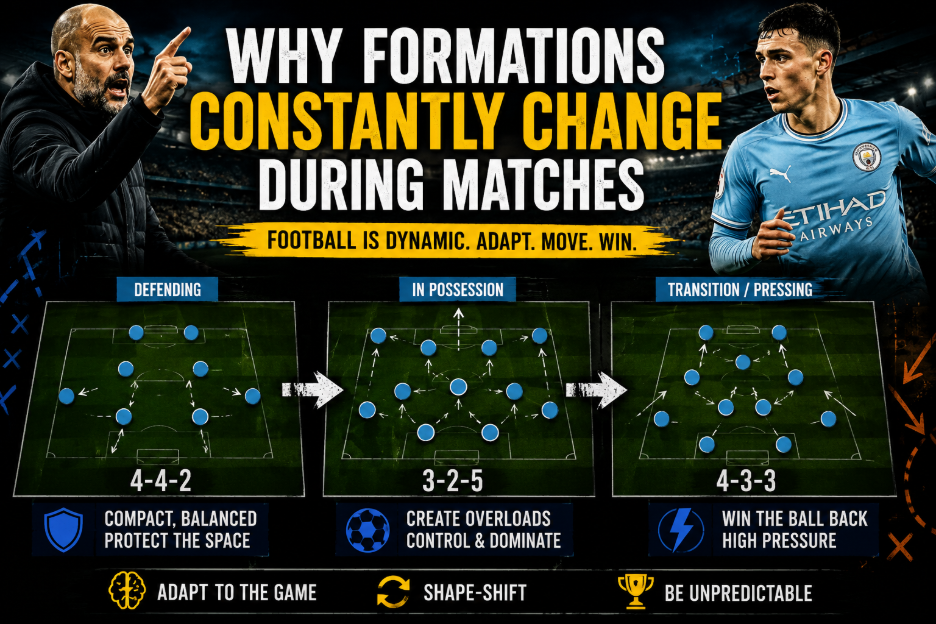
A team may start in a:
- 4-3-3 while defending
- 3-2-5 while attacking
- 4-4-2 during pressing
—all within the same match.
👉 Today’s football is about movement and adaptation, not static shapes.
🧠 Formations Are Only Starting Points
The formation shown before kickoff is just the base structure.
Once the game begins:
- Players rotate
- Fullbacks invert
- Midfielders drop deeper
- Wingers move inside
👉 The team shape constantly changes depending on the situation.
⚡ Why Teams Change Shape
Football is a game of:
- Space
- Numerical advantages
- Positional control
Changing formations helps teams:
- Create overloads
- Control possession
- Break defensive structures
- Press more effectively
🔄 Attacking vs Defensive Shapes
Most teams use different structures:
- In possession
- Out of possession
Example:
- A 4-3-3 may become a 3-2-5 in attack
- The same team may defend in a 4-4-2 block
👉 Shape changes are now a tactical necessity.
🎯 Fullbacks Changed Everything
Modern fullbacks are key to shape changes.
They may:
- Push high like wingers
- Move inside as midfielders
- Stay deep to form back threes
Managers like Pep Guardiola use inverted fullbacks to control midfield spaces during buildup.
⚙️ Rotations Create Uncertainty
Positional rotations confuse defenders.
When players swap zones:
- Marking becomes difficult
- Passing lanes open
- Defensive shape stretches
This movement creates:
👉 Tactical chaos for opponents.
🌟 Pressing Also Changes Formations
Pressing structures are often different from attacking structures.
For example:
- Wingers may press centrally
- Midfielders step higher
- Strikers block passing lanes
Teams adjust shape depending on:
- Opponent buildup
- Ball location
- Match situation
🧩 Modern Football Is Fluid
Rigid formations are disappearing.
Today’s football values:
- Flexibility
- Adaptability
- Spatial occupation
Players are expected to:
- Understand multiple roles
- Rotate intelligently
- Maintain structure during movement
⚠️ Why This Is Difficult
Constant shape changes require:
- Communication
- Tactical awareness
- High football IQ
If rotations fail:
- Space opens defensively
- Pressing becomes disorganized
- Transitions become dangerous
That’s why elite teams train these movements repeatedly.
🔍 Tactical Insight
Modern formations are better understood as:
👉 Dynamic systems rather than fixed numbers.
The numbers (4-3-3, 3-4-2-1, etc.) only describe:
- Starting positions
—not actual match behavior.
⚡ Final Thought
Football formations no longer stay still.
The best teams constantly adapt:
- To space
- To pressure
- To game situations
Because modern football is not about standing in positions—
👉 It’s about moving intelligently between them.