
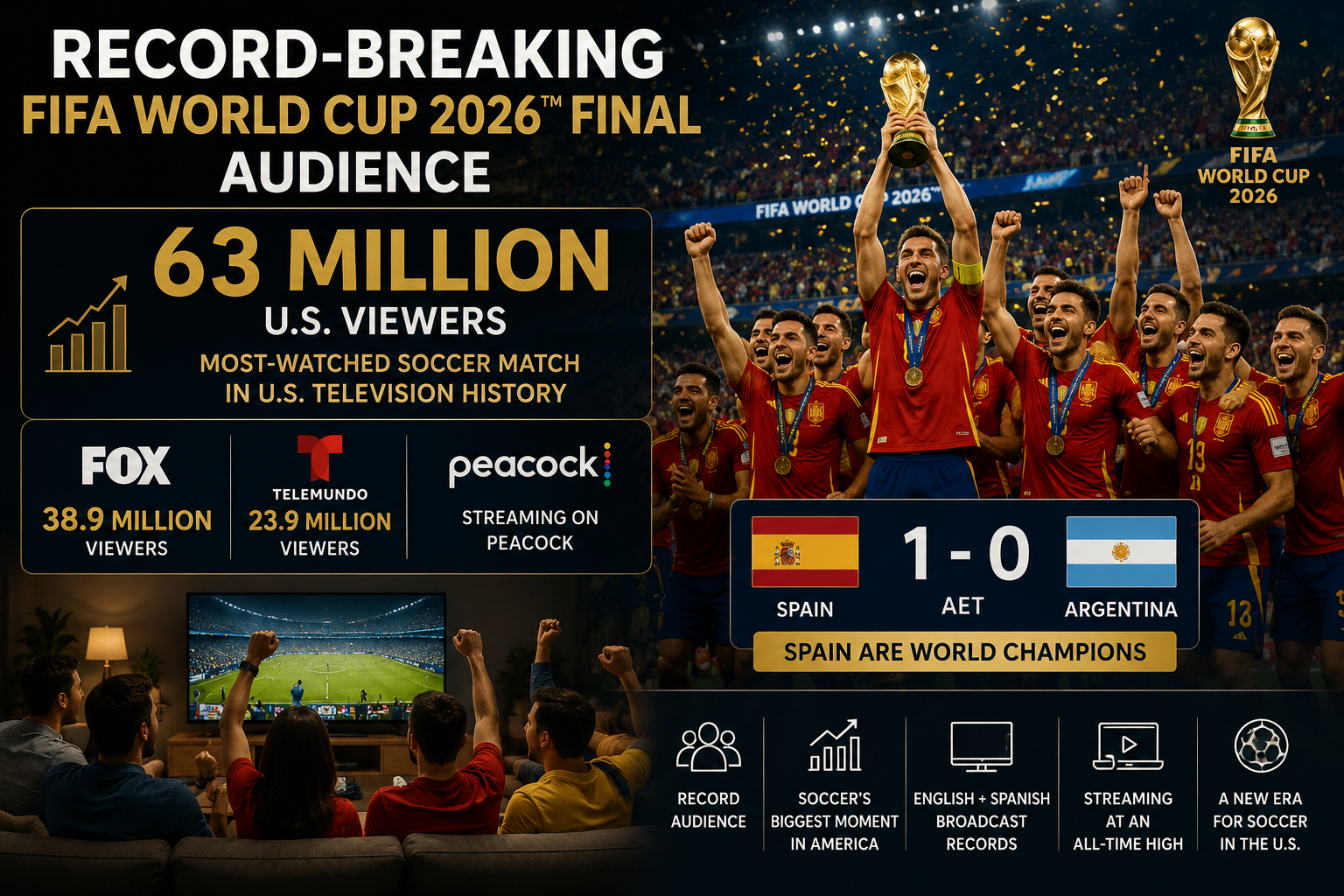
World Cup 2026 Final Audience figures reached historic levels as nearly 63 million Americans watched Spain defeat Argentina 1-0 after extra time. The World Cup 2026 Final Audience became the largest in U.S. television history, proving that football has become a mainstream sport in America. This record-breaking World Cup 2026 Final Audience highlights the sport’s growing popularity across television and streaming platforms.
For decades, football was often described as a growing sport in the United States. The FIFA World Cup 2026 final proved that growth has become reality.
A Historic Television Audience
Spain’s victory over Argentina attracted viewers across English and Spanish-language broadcasters.
Fox’s English-language broadcast averaged 38.9 million viewers, while Telemundo and Peacock added another 23.9 million viewers, producing a combined audience of nearly 63 million Americans.
That total almost tripled the U.S. audience for the 2022 FIFA World Cup final between Argentina and France.
It also established new records for:
- Most-watched soccer match in U.S. television history
- Most-watched FIFA World Cup Final in the United States
- Most-watched Spanish-language soccer broadcast in U.S. history
The numbers confirmed that football has entered the American sporting mainstream.
Why So Many Americans Tuned In
Several factors combined to create record-breaking interest.
1. Perfect Kick-off Time
Unlike previous World Cups played in Asia or the Middle East, matches in the United States were scheduled during ideal viewing hours for American audiences.
The final kicked off on a Sunday afternoon, making it accessible to millions of casual sports fans.
2. Lionel Messi’s Possible Final World Cup
Many supporters believed this could be Lionel Messi’s final FIFA World Cup appearance.
Even casual sports fans wanted to watch one of football’s greatest players compete on the biggest stage for what may have been the last time.
Messi’s global popularity helped attract viewers who do not normally follow football regularly.
3. Spain’s Rise
Spain entered the final after producing the tournament’s best football.
Their possession-based style, outstanding defence, and exciting young stars such as Lamine Yamal created enormous interest throughout the knockout stages.
Fans wanted to see whether Spain could complete their remarkable campaign.
4. Growth of Streaming
Streaming played a major role.
Fox One experienced its strongest month since launch, while Peacock also attracted huge audiences through Telemundo’s Spanish-language coverage.
Football is no longer watched only on traditional television.
Millions now consume major sporting events across multiple digital platforms.
Football Outperformed Other Major U.S. Sports
One of the biggest surprises was how several World Cup matches compared with other major American sporting events.
The Round of 16 meeting between England and Mexico attracted nearly 45 million viewers, comfortably exceeding recent NBA Finals and World Series championship audiences.
Although the World Cup Final remained below the Super Bowl’s audience, it established football as one of the largest sporting television events in the United States.
That would have seemed almost impossible just a generation ago.
The Power of Hispanic Audiences
Spanish-language coverage played an enormous role in the record numbers.
Telemundo and Peacock combined for almost 24 million viewers, underlining football’s enormous popularity within Hispanic communities across the United States.
Football has always been deeply connected to Hispanic culture in America.
The FIFA World Cup 2026 demonstrated how that audience continues to grow while also attracting increasing numbers of English-language viewers.
The result is a broader football audience than ever before.
Commercial Success Beyond the Pitch
The television audience also created enormous commercial value.
Advertising demand reached record levels throughout the knockout stages.
According to Reuters, premium 30-second advertising slots during major knockout matches reached approximately $1 million, with global brands including Coca-Cola, PepsiCo, Home Depot and Anheuser-Busch investing heavily.
Broadcasters also benefited from:
- Higher subscription numbers
- Increased streaming engagement
- Record advertising revenue
- Greater sponsorship exposure
The success is expected to increase the value of future FIFA broadcasting rights.
The Impact of the 48-Team World Cup
Some critics questioned whether expanding the tournament from 32 to 48 teams would reduce quality.
Instead, the competition produced:
- 104 matches
- New football nations reaching the knockout rounds
- More dramatic storylines
- Record stadium attendance
- Record television audiences
- Unprecedented digital engagement
Rather than diluting the tournament, the expanded format created more stories for supporters around the world.
Why This Matters for American Soccer
The importance of these viewing figures extends far beyond one football match.
Record television audiences influence every part of the sport:
- Increased youth participation
- Greater investment from sponsors
- Higher broadcasting revenue
- More attractive commercial partnerships
- Larger audiences for MLS and international football
- Stronger business case for future football events
Every major sport grows through visibility.
The FIFA World Cup 2026 provided football with its biggest American audience ever.
A Turning Point for Football
For many years, football supporters believed the United States had enormous potential.
The FIFA World Cup 2026 showed that potential becoming reality.
Nearly 63 million viewers watched one match.
Millions more followed highlights across social media, streaming platforms and digital news outlets.
The tournament demonstrated that football can compete alongside America’s biggest sporting events while reaching entirely new audiences.
Final Thoughts
The FIFA World Cup 2026 final will be remembered for Spain’s victory, Ferran Torres’ extra-time winner and another emotional chapter in Lionel Messi’s remarkable career.
It should also be remembered for something equally important.
Nearly 63 million Americans watched the final, making it the biggest football broadcast in U.S. history.
That number represents more than a television record.
It represents a new era for football in the United States.
As the sport continues to grow through broadcasting, streaming and youth participation, the FIFA World Cup 2026 may one day be remembered as the tournament that truly transformed football from a growing sport into a mainstream American sporting event.
Internal Links
- https://enigmafootball.com/world-cup-2026/
- https://enigmafootball.com/football-news/
- https://enigmafootball.com/match-analysis/