
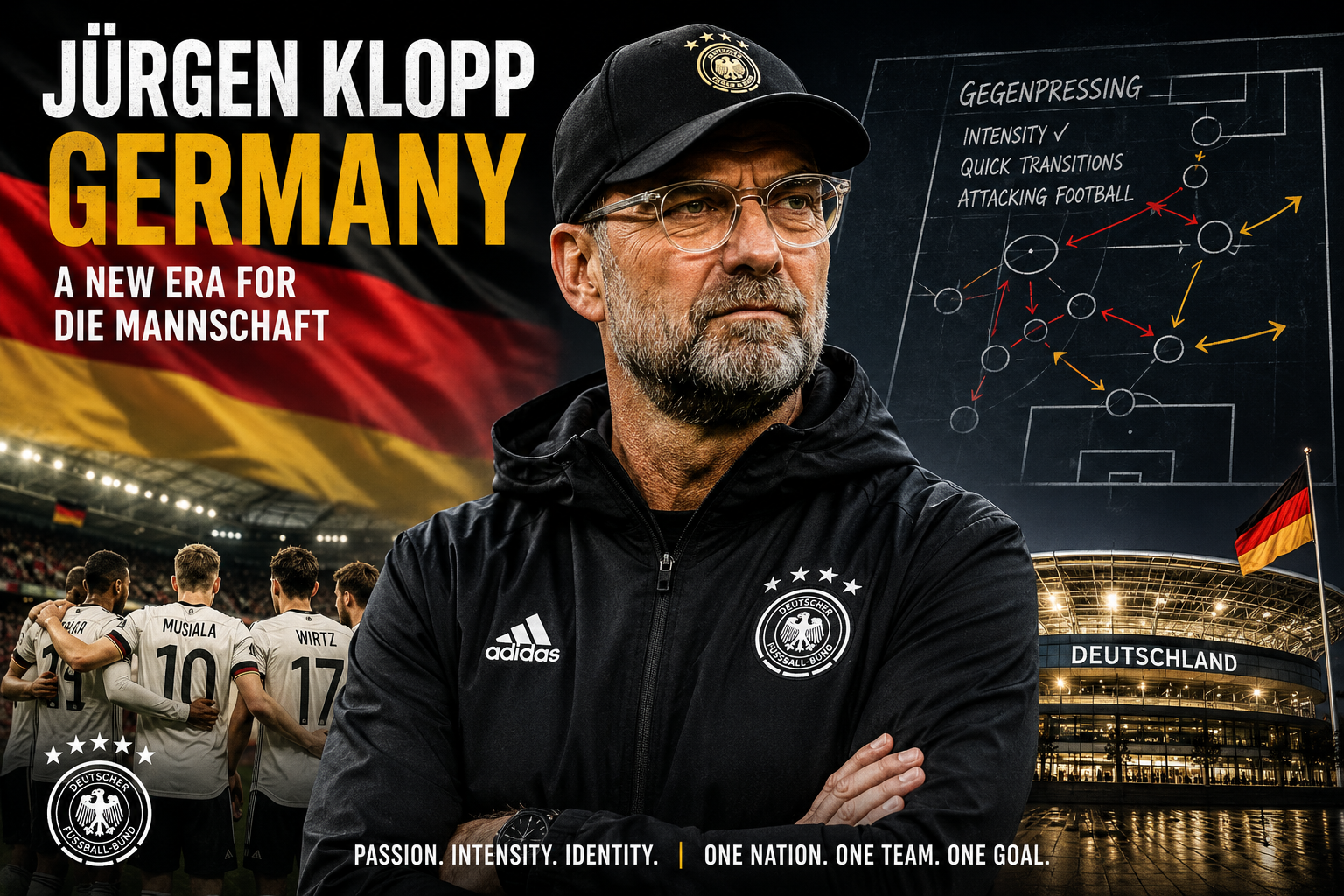
Jürgen Klopp Germany is one of the biggest stories in international football. Following Germany’s disappointing FIFA World Cup 2026 campaign, Klopp has been appointed head coach with the task of rebuilding the four-time world champions. His aggressive pressing, high-intensity football and ability to develop young talent could transform the national team ahead of Euro 2028 and the 2030 FIFA World Cup.
However, his new challenge is very different.
International managers have limited training time, no transfer market and little opportunity to correct tactical problems between matches. Klopp must adapt the methods that made him successful at club level to the slower rhythm and shorter preparation periods of international football.
What will Germany look like under Jürgen Klopp? Here are the changes supporters can realistically expect.
Why Germany Chose Jürgen Klopp
Germany’s latest World Cup disappointment increased the pressure for meaningful change.
The four-time world champions were eliminated in the group stage in 2018 and 2022 before losing to Paraguay on penalties in the Round of 32 at the 2026 tournament. Klopp now inherits a team that has failed to win a World Cup knockout match since lifting the trophy in 2014.
The German Football Association described Klopp as its preferred candidate following Nagelsmann’s departure.
DFB president Bernd Neuendorf said Klopp represented passion, credibility and the ability to bring people together. Klopp, meanwhile, described the national-team position as the high point of his coaching career.
His appointment is not simply about selecting a famous manager.
Germany need a clear identity, stronger emotional energy and a team capable of performing under tournament pressure. Those are areas in which Klopp has built his reputation.Jürgen Klopp Germany
A More Intense German Team
The most obvious change will be intensity.
Klopp has already said Germany should not attempt to copy Spain, Argentina, England or France. He wants the team to develop its own identity and play in a recognisably German way, with greater aggression and tempo.
Supporters should expect Germany to press opponents earlier and more aggressively.
Instead of retreating into a passive defensive block, Klopp’s team will attempt to force mistakes near the opponent’s goal. The forwards will close down defenders, midfielders will step forward to block passing options, and the defensive line will move higher to keep the team compact.
This approach is often associated with gegenpressing, the idea of immediately attacking the ball after possession is lost.
The aim is not merely to recover possession. It is to win the ball while the opponent is disorganised and create a scoring chance before the defence can recover.
Faster Attacks After Winning Possession
Germany have sometimes appeared slow and predictable when building attacks.
Klopp is likely to demand quicker decisions.
When Germany recover the ball, the first pass may go forward rather than sideways. Wingers will be encouraged to run behind the defence, midfielders will attack open spaces, and the centre-forward will be expected to create room for others through movement.
This does not mean Germany will abandon possession.
Klopp’s best teams were capable of controlling the ball for long periods. The difference was that possession had a clear purpose. Passes were used to move defenders, create space and prepare an explosive attack.
Germany’s football may therefore become more direct without becoming careless.
Greater Importance for Wingers
Wide players are likely to become central to Klopp’s tactical plan.
During his unveiling, Klopp spoke about developing a distinctive and intense style rather than copying the strongest international sides. His previous teams regularly used quick wingers to stretch the pitch and attack isolated defenders.
Germany possess several players who could benefit from this approach.
Jamal Musiala can begin from a wide position before moving into central areas. Florian Wirtz can operate between the lines, while younger wide players may receive opportunities if they demonstrate the pace and discipline required by Klopp’s system.Jürgen Klopp Germany
The wingers will not only be judged by goals and assists.
They must also press full-backs, track runners and react immediately when possession changes.
Under Klopp, attacking players are usually the first defenders.
Musiala and Wirtz Could Become the Creative Core
Germany’s future will probably be built around Jamal Musiala and Florian Wirtz.
Both players are comfortable receiving the ball in tight areas, carrying it through midfield and creating opportunities near the penalty area.
The challenge will be fitting them into the same team without making Germany unbalanced.
Klopp could use one player centrally and the other from a wide position. He could also place both behind a striker in certain matches, provided the midfield behind them offers enough protection.
Rather than forcing Musiala and Wirtz to remain in fixed positions, Klopp is likely to encourage movement and rotation.
One player may drop toward midfield while the other runs beyond the striker. Their ability to exchange positions could make Germany far less predictable.
A More Demanding Role for the Centre-Forward
Klopp’s striker will need to do much more than score goals.
The centre-forward must lead the press, challenge defenders, protect the ball and create space for midfield runners.
Germany have struggled to establish a consistent first-choice striker in recent years. Klopp may therefore judge forwards according to how well they serve the team rather than simply their individual scoring totals.
A striker who presses intelligently and connects attacks could be preferred over a more talented finisher who contributes little without the ball.
This may create opportunities for younger forwards or players previously viewed as squad options.
Midfield Balance Will Be Crucial
Klopp’s football requires enormous energy, but intensity without control can leave a team exposed.
Germany’s midfield must provide both.
One midfielder will usually remain behind the attack to protect against counter-attacks. Another may press forward or carry the ball into advanced areas. The balance between those roles will determine whether Germany become exciting or simply vulnerable.
Joshua Kimmich’s role will be one of Klopp’s most important early decisions.
Kimmich can play in midfield or at right-back and offers leadership and passing quality. However, Germany must decide whether he remains central to the next cycle or becomes an experienced figure supporting a younger core.
Klopp is unlikely to remove every senior player immediately.
His official comments stressed humility, patience and the development of a team that fights for one another. That suggests evolution rather than change for its own sake.
A Higher Defensive Line
Germany’s defenders should expect to play further from their own goal.
A high defensive line helps the team remain compact and supports aggressive pressing. When the forwards apply pressure, the defenders must move forward rather than leaving a large space in midfield.
This approach carries risk.
Centre-backs must be comfortable defending one-on-one situations and chasing attackers running into space. The goalkeeper must also be willing to leave the penalty area and act as an extra defender.
Klopp will therefore need defenders with pace, concentration and confidence on the ball.
Reputation alone may not guarantee selection.
Younger Players Will Receive Opportunities
The DFB highlighted Klopp’s record of developing young players when announcing his appointment.
At Dortmund and Liverpool, he improved emerging footballers by giving them clear responsibilities within an established system.
Germany can expect a similar approach.
Klopp may identify players from the Under-21 team, the Bundesliga and other European leagues who fit his tactical demands. A young player who presses aggressively and follows instructions may become more valuable than an established name who does not suit the system.
However, he is unlikely to field an inexperienced team simply to appear revolutionary.
Klopp has always valued leadership. The probable plan is to combine young talent with a smaller group of experienced players capable of guiding them.
Stronger Team Spirit
Klopp’s influence extends beyond tactics.
His best teams played with a visible emotional connection. Players celebrated defensive actions, supported one another after mistakes and appeared to believe in a shared purpose.
Germany have not always shown that unity during recent tournaments.
The new manager will attempt to rebuild it.
Klopp has said the national team can connect the German public in a way few other institutions can. He wants to create a side that enjoys football, fights collectively and earns the country’s support.
This may become one of his most important tasks.
Tactical plans matter, but international tournaments are often decided by confidence, trust and the ability to survive difficult moments.
Familiar Assistants Will Help the Transition
Klopp will not begin the project alone.
Peter Krawietz, Pep Lijnders and former Germany international Sven Bender will join his coaching staff. Krawietz and Lijnders worked closely with Klopp at Liverpool, while Bender brings recent experience in German football and the DFB youth system.Jürgen Klopp Germany
Their presence should make the transition easier.
Krawietz is known for match analysis, Lijnders has played an important role in training design and tactical preparation, and Bender can provide a connection to German players and youth development.
International breaks are short, so the coaching staff must communicate ideas quickly.
Having trusted assistants who already understand Klopp’s methods will be valuable.
What Klopp Cannot Change Immediately
Expectations should remain realistic.
Klopp himself has warned that his appointment does not automatically make Germany world champions. He acknowledged that several teams currently appear stronger, although he believes Germany can defeat them with outstanding and intense football.
He cannot sign new players.
He cannot train the squad every day.
He cannot rebuild Germany’s youth system within a few international windows.
The first matches may therefore look imperfect. Pressing movements require coordination, and mistakes are likely while players adjust to new responsibilities.
Germany’s supporters may need patience before the full effect becomes visible.
Klopp’s First Matches
Klopp’s first match will be against the Netherlands in Amsterdam on September 24.
Germany will then face Greece in Augsburg on September 27, Serbia in Munich on October 1 and Greece again in Thessaloniki on October 4.
These fixtures will provide an early indication of his priorities.
Supporters should watch for the height of Germany’s defensive line, the speed of their transitions and which players lead the press.
Team selection will also reveal whether Klopp intends to begin with experienced names or accelerate the generational change immediately.
Can Klopp Make Germany Champions Again?
Klopp has the personality and experience to improve Germany.
He understands German football, has succeeded under intense pressure and has repeatedly created teams that perform above the sum of their individual parts.
However, international football presents a new challenge.
He must simplify complex ideas, manage players from different clubs and create tournament-level consistency with very little preparation time.
Euro 2028 will provide the first major judgment of the project. The World Cup in 2030 is the longer-term target.
Germany do not need to become Liverpool or Borussia Dortmund.
They need to become a stronger, faster and more united version of themselves.
Final Thoughts
Jürgen Klopp’s Germany revolution will not be based on one dramatic formation change.
It will be built through intensity, faster attacking football, aggressive pressing, clear roles and stronger emotional unity.
Young players should receive opportunities, but experienced leaders will still matter. Musiala and Wirtz may become the creative centre of the side, while every player will be expected to contribute without the ball.
Most importantly, Klopp will try to restore Germany’s identity.
The national team have spent several years searching for direction. They now have a coach whose football is immediately recognisable and whose personality can reconnect the players with the public.
The revolution may require patience.
But for the first time in years, Germany supporters can see a clear idea of what their team might become.
Internal Links
- https://enigmafootball.com/fifa-world-cup-2026-awards/
- https://enigmafootball.com/how-spain-won-fifa-world-cup-2026/
- https://enigmafootball.com/lionel-messi-world-cup-2026/